The Difference Between a Fund and a Syndication Is Asset Identification
Are syndications and funds legally different things? No. From a securities-law standpoint, a fund and a syndication are the same thing: pooled capital raised from investors for a common purpose.
The label you pick does not change the exemption you rely on. Both live under the same Regulation D entity framework. What actually changes your legal paperwork is one thing: whether you have identified a specific asset upfront, or you are raising a blind pool to buy something later.
That distinction is the whole article. Get it right and your documents make sense. Get it wrong and you have built the wrong package.
The Market Labels vs. The Legal Reality
Legally, “syndication,” “fund,” and “capital group” are interchangeable. They all describe a sponsor raising money into an issuer, with investors buying interests and the sponsor managing the entity. The SEC does not care what you call it. It sees pooled capital used for a common purpose, offered under an exemption like Rule 506(b) or Rule 506(c).
The market uses the words differently, and that is where the confusion starts.
In practice, people say “syndication” when there is one identified asset. You have a building under contract, or a single operating company you are buying, and you raise money to close on that specific thing.
People say “fund” when there are multiple assets, or when the assets have not been identified yet. The sponsor is raising a pool and will deploy it into deals over time.
So the words are describing a business model. They are not describing a different statute.
The Core Legal Divider: Asset Identification
Asset identification is the real line. It means you know exactly what the money is buying before investors commit.
If you have Property A under contract, or a specific target company, your investors are buying into a known thing. That is an identified-asset deal.
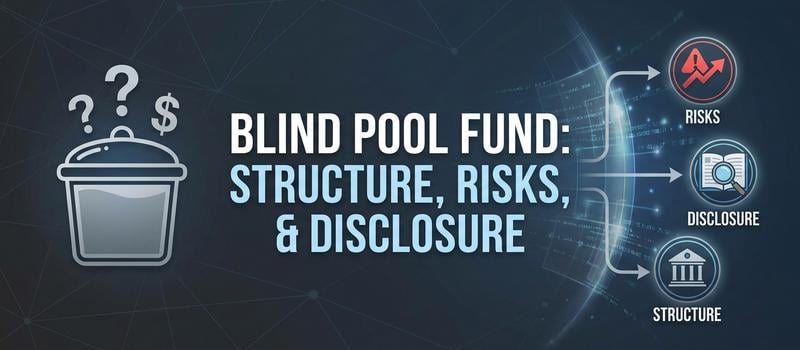
The moment you decide to raise capital without a specific asset locked down, you have created a blind pool. Investors are handing you money based on a mandate – your criteria, your discipline, your track record – not a tangible asset they can underwrite today.
That shift matters because it changes the risk the investor is taking. In an identified-asset deal, the investor is mostly evaluating the asset. In a blind pool, the investor is mostly evaluating you.
And once the risk profile changes, the documents have to change with it. The disclosures in the Private Placement Memorandum and the mechanics in the Operating Agreement both get rewritten – not tweaked – because they now have to describe a different bet.
Moving from Property Risk to Manager Risk
When the asset is not identified, the investor is no longer underwriting the specific asset – they are underwriting you. In a single-asset syndication, investors evaluate the deal in front of them. In a blind-pool fund, they evaluate the sponsor. That shift is the whole reason the disclosure package has to change.
The Single-Asset Evaluation
In a standard syndication, the investor can look at the actual asset.
They can review the property, the financial statements, or the contracts tied to the deal, and underwrite the specific asset. Whether it is real estate, an operating company, or a debt position, the idea is the same – there is a defined thing to analyze. The investor knows what they are buying.
The primary risk is tied to that identified asset and its market. Market shifts, lost contracts, revenue declines – those are the risks the investor is weighing. The sponsor still matters, but the sponsor is executing on something the investor can see and price today.
The Blind-Pool Bet
A blind-pool fund asks the investor to commit capital based on a mandate, not a specific asset.
There is no asset to inspect and no financial statements to review yet. The investor is handing over money based on a set of criteria – the asset class, the geography, the leverage limits, the return target – and trusting the manager to go find deals that fit. That is a different question entirely.
So the investor is betting on the manager’s discipline, deal flow, and track record. The investor is evaluating whether this sponsor can actually source good deals. The investor is also evaluating whether the sponsor will stay inside the mandate when the market gets thin, rather than buying something marginal just to put the capital to work. From the investor’s point of view, that discipline is the real product.
This is why a fund is a harder sell for a first-time sponsor. With no assets identified, there is nothing tangible to point at, so the investor is relying almost entirely on their read of you. That trust gap is the practical problem a blind pool creates, and it drives what the PPM has to disclose.
Why Your PPM Disclosures Must Transform for a Blind Pool
When you move from an identified asset to a blind pool, the Private Placement Memorandum has to change what it discloses. A single-asset PPM tells the investor about the thing they are buying into. A blind-pool PPM cannot do that, because the thing does not exist yet.
So the disclosure focus shifts. You stop disclosing the asset and start disclosing the manager, the strategy, and the risk of buying nothing at all.
Regulation D does not hand you a checklist for this. It requires that you not mislead investors and that you disclose the material facts they need to make a decision. In a blind pool, the material facts are different, so the document has to be different.
Dropping Property-Specific Disclosures
In a single-asset deal, most of the risk section is about one asset. The roof, the rent roll, the anchor tenant, the zoning fight with the city, the deferred maintenance the seller ignored for a decade.
None of that belongs in a blind-pool PPM, because you do not own any of it yet. You cannot disclose the condition of a building you have not identified.
If you leave that language in, you are describing risks that do not apply and creating the impression that you know something you do not. That is a disclosure problem, and it is one you created for no reason.
Adding Manager-Thesis and Strategy Disclosures
A blind-pool PPM replaces the asset disclosures with the mandate. The investor is buying your discipline and your judgment, so the document has to spell out how you will use both.
That means disclosing your investment criteria clearly. What asset class, what geography, what deal size, what leverage limits, what hold period. The mandate is what the investor is actually underwriting, so it needs to be specific enough to mean something and broad enough that you can still operate.
Then you disclose the risks that come with a blind pool. The big one is that you may not find suitable assets on your terms. If the market moves against you, you could sit on committed capital with nowhere good to put it.
That leads to cash drag. Money that is raised but not yet deployed is not earning the return the investor came for, and the PPM has to say so plainly.
You also disclose the obvious point that the investor is relying on you. Your track record, your deal flow, your ability to execute the thesis. If those are thin, say so. Thin experience is a fact you disclose, not a fact you hide.
Here is why this matters beyond good drafting. If you run a blind pool on documents that never disclosed the blind-pool risks, you have an offering that may not hold up. Depending on the facts and the applicable law, that gap can expose you to regulatory scrutiny and investor claims. The disclosure is not a formality. It is the thing that protects you when a deal does not go the way everyone hoped.
Re-Architecting the Operating Agreement Mechanics
The Operating Agreement for a multi-asset fund needs expanded manager discretion, capital call mechanics, and portfolio-wide waterfalls. None of that belongs in a single-asset deal. Put those tools in a single-asset Operating Agreement and you have given yourself powers you cannot use and rules that do not match the deal.
The reason is simple. A single-asset syndication has one job: buy the asset, run it, sell it, distribute the money. A fund has to keep buying, selling, and reinvesting over time. The document has to let the manager do that.
Expanded Manager Discretion
A fund’s Operating Agreement must explicitly grant the manager the right to select, buy, and sell assets without an investor vote. That is the whole point of a blind pool. Investors gave you money to go find deals inside the mandate, not to approve each one.
In a single-asset deal, you do not need that. Everyone already knows the asset. There is nothing to vote on because there is nothing left to decide.
In a fund, if you make the manager go back to investors for permission on every acquisition or disposition, you have built a machine that cannot run. You will miss deals waiting for consents. You will get stuck holding an asset because you cannot get a vote to sell.
When we build a fund and syndication legal structure, we focus heavily on protecting the sponsor’s discretion to actually operate the portfolio without returning to investors for permission. That discretion is disclosed up front in the PPM, so investors know exactly what they are handing over.
Multi-Asset Waterfalls and Compensation
A single-asset waterfall usually triggers on one capital event: the sale of the asset. Money comes in, you run it through the tiers, everyone gets paid, the deal is over.
A fund waterfall has to handle several assets bought and sold at different times. You have differing hold periods, differing returns, and money coming back in waves rather than all at once. The waterfall has to decide how those events combine.
That raises questions a single-asset waterfall never asks. Do you calculate the preferred return across the whole fund or asset by asset? Does a loss on one asset offset a gain on another before the manager takes a promote? Can the manager recycle proceeds into a new asset instead of distributing them? You have to answer these in the document, because if you do not, the manager and the investors will read the blank differently the moment real money is on the table.
The fee structure usually shifts too. A single-asset deal often pays a one-time acquisition fee. A fund typically layers in an ongoing management fee on assets under management, because the manager is running a portfolio over years, not closing one purchase.
Capital Calls and Recycling
Funds often take capital commitments rather than all the cash up front. Investors commit a dollar amount, and the manager calls that capital as deals come in. That way the fund is not sitting on idle cash it cannot invest yet.
That tool creates a problem you have to solve in the Operating Agreement: what happens when an investor does not fund the call. If someone commits a million dollars and then defaults on the call, the fund still owes money on a deal it planned around.
So the document needs real consequences for a default. Common approaches include diluting the defaulting investor’s interest, charging interest, forcing a sale of their interest, or cutting off distributions until they cure. You want those mechanics written before you ever make a call, not negotiated with an angry investor after one fails to pay.
Recycling is the other piece. If you want the ability to reinvest sale proceeds into new assets during the investment period instead of distributing everything, the Operating Agreement has to permit it and the PPM has to disclose it. A single-asset deal never needs this. A fund that plans to compound capital over its life cannot function without it.
The Danger of ‘Tweaking’ Single-Asset Documents
No, you cannot just add a clause to your existing deal docs and call it a fund. Pasting multi-asset rights into a single-asset Operating Agreement creates conflicting rules, disclosure gaps, and investor friction you do not need.
The instinct makes sense. You already paid for one legal package. Doing it again feels like paying twice for the same thing. But a single-asset package and a fund are not the same document with one paragraph changed. They are built to do different jobs.
The Temptation to Cut Corners
The exact mistake is this: a sponsor takes the single-asset package from a prior deal, adds a sentence saying “the Manager may acquire additional properties,” and assumes they now have a fund.
They think they bought fund flexibility on the cheap. They did not. They bought a single-asset deal with a sentence in it that the rest of the document cannot support.
The sentence grants a right. Nothing else in the package explains that right, discloses its risks, or gives the Manager the mechanics to actually use it.
The Operational and Legal Fallout
The disclosure problem shows up first. Your PPM was written to describe one asset. It has no investment mandate, no discussion of the risk that you never find a second deal, no cash-drag disclosure, and no blind-pool risk factors. So the moment you decide to raise money for unidentified assets, your PPM is describing an offering that no longer exists.
The Operating Agreement fails next. A single-asset waterfall is built to trigger on one capital event. It has no mechanics to distribute cash from Property B while Property A is still operating, no way to handle different hold periods, and no framework for recycling capital. When the second deal closes, you are trying to run a portfolio through a document that only knows how to run one building.
The Subscription Agreement locks the problem in place. Your investors signed based on the deal the documents describe. If the real deal is a multi-asset fund, you have a mismatch between what they agreed to and what you are actually doing.
That is the box. You made a promise the rest of your legal package cannot keep, and you cannot cleanly fix it after the money is in without going back to your investors. If you want to operate like a fund, build the fund. Do not find-and-replace your way into one.
The Semi-Blind Pool: Anchoring with a Seed Asset
There is a middle option between a single-asset syndication and a pure blind pool. It is the semi-blind pool, and for most first-time fund managers, it is the right place to start.
A semi-blind pool identifies one initial asset to anchor the offering while legally structuring the vehicle to raise additional capital for future, unidentified assets. The investor gets something concrete to look at today, and the sponsor gets the flexibility to keep buying tomorrow.
How a Semi-Blind Pool Works
The structure is simple. The sponsor already has Asset A under contract or in hand.
The legal documents are built as a fund, not as a single-asset deal. That means multi-asset mechanics, broad manager discretion, portfolio-level waterfalls, and the capital-call and recycling provisions a real fund needs.
The PPM discloses Asset A specifically – what it is, what it costs, how it performs, what the risks are. Then the same PPM lays out the mandate for the assets that come after it: the asset class, the geography, the leverage limits, and the criteria the manager will use to buy Assets B, C, and D.
So the investor is underwriting one real thing plus a disclosed strategy for everything else. The disclosure covers both the identified asset and the blind-pool risk on the rest.
Solving the Investor Trust Gap
The practical problem with a pure blind pool is sales, not law. You can legally raise a blind pool. Investors just do not like handing money to a first-time manager based on a mandate and nothing else.
Blind pools work when the sponsor has a long multi-fund track record. If you do not have that yet, a pure blind pool is a hard raise.
A seed asset fixes that. It gives the investor a tangible deal to evaluate immediately, which makes the conversation easier and the check faster. They are betting on you, but they are also looking at something real.
From your point of view, the bigger win is what it does for the next deal. You are not spinning up a brand-new entity and a brand-new legal package every time you find a property.
You built the fund once. You buy Asset B inside the same vehicle, under the same documents, with the same investors. That is the whole point – you get to scale without starting over.

Tilden Moschetti, Esq., is a highly sought-after syndication attorney with nearly two decades of experience. His clientele ranges from real estate developers and startups to established businesses and private equity funds. Tilden’s expertise in syndication law comes not only from his knowledge of syndication and securities law but from real, hands-on experience as an active syndicator himself in every real estate product type and nearly all markets in the US. His knowledge and experience set him apart and established him as the Reg D legal services leader.