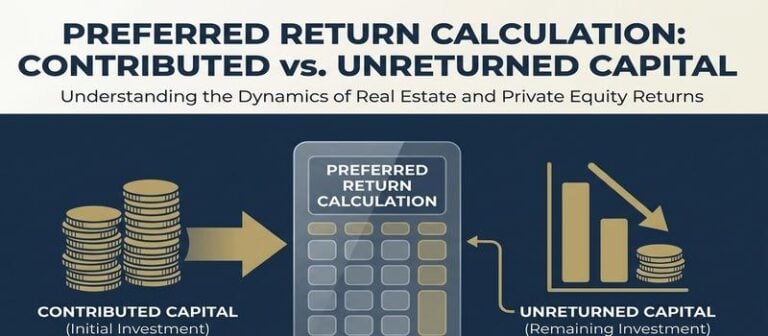
The Core Distinction: What Happens When Operating Cash Falls Short?
If your deal doesn’t throw off enough cash to pay the full preferred equity return in a given year, the answer depends on one word in your Operating Agreement: cumulative or non-cumulative. Under a cumulative structure, the unpaid portion carries forward and sits in line ahead of everything else next year. Under a non-cumulative structure, the shortfall disappears when the period closes, and the investor doesn’t get it back.
Both of these are just rules for splitting whatever equity cash is available. Neither one is a bill the sponsor has to pay.
The Carryforward Mechanic of a Cumulative Return
A cumulative preferred return means the priority accrues whether or not there’s cash to satisfy it. If the fund promised an 8% pref and only had enough cash to cover 3% this year, the other 5% doesn’t vanish. It rolls into next year and stands first in line for the next round of distributable cash, before the sponsor sees any split.
So the balance keeps a running tally. Whatever the investor didn’t receive this period gets added to what they’re due next period, and the sponsor has to clear all of it before moving down the waterfall.
The Use It or Lose It Reality of Non-Cumulative Returns
Non-cumulative works the opposite way. Once the distribution period ends, the unpaid portion is gone. There’s no running balance and nothing to make up next year.
If Susan is entitled to an 8% non-cumulative pref and the deal only pays her 3% this year, next year she starts fresh at 8% again. The 5% she missed isn’t waiting for her. It’s use it or lose it for that specific window, and each window stands on its own.
Why Preferred Returns Are Not Owed
The language around this trips a lot of people up because the market keeps borrowing loan words for an equity return. Unpaid preferred return isn’t a debt, it isn’t interest, and the sponsor doesn’t owe it the way a borrower owes a lender.
A preferred return is a distribution priority. It tells you the order in which equity cash gets paid out, and nothing more. If the cash isn’t there, missing the pref doesn’t put the sponsor in default, doesn’t trigger a lender’s remedies, and doesn’t create a claim the investor can enforce like a note. The investor is still an owner standing in line, first in line, but in line, not a creditor holding a debt instrument. That distinction runs through everything else in how these structures actually behave.
A Two-Year Shortfall: The Mechanics in Action
The definitions are easier to hold onto once you put numbers behind them, so let’s give Bob a check and watch what happens over two years.
Year One: The $50,000 Shortfall
Bob invests $1,000,000 in the fund at an 8% preferred return. That means his priority for the year is $80,000, and he sits ahead of the sponsor’s promote for that amount.
The asset has a rough first year. After operating expenses and the reserves the Operating Agreement requires, the fund only produces $30,000 in distributable cash. Bob gets all $30,000, because he’s first in line, but there’s nothing left to fill the rest of his priority. He’s short $50,000 for the year.
What happens to that $50,000 next year is the entire question, and it turns on one word in the document.
Year Two Under a Cumulative Structure
If the Operating Agreement says the preferred return is cumulative, that $50,000 doesn’t disappear. It carries forward and stacks on top of Bob’s Year 2 priority.
So in Year 2 Bob’s priority is his new $80,000 base plus the $50,000 from last year, which is $130,000. The sponsor has to distribute a full $130,000 to Bob before a dollar of Year 2 cash flow reaches the GP’s split. If the fund throws off, say, $110,000 in Year 2, all of it goes to Bob and he’s still $20,000 short, which itself carries into Year 3 under the same mechanic.
The carryforward is just a running priority number. It grows because periods get added to it, not because the balance earns anything on itself, and I’ll come back to that distinction because it’s where a lot of sponsors talk themselves into trouble.
Year Two Under a Non-Cumulative Structure
Run the same first year, but this time the document says the return is non-cumulative.
Now Year 2 opens with a clean slate. Bob’s priority resets to $80,000, and the $50,000 he missed in Year 1 is gone for good. Nobody’s holding it against future cash flow.
Say the asset recovers and produces $100,000 of distributable cash in Year 2. Bob takes his $80,000 priority, and the remaining $20,000 drops immediately into the next tier of the waterfall, which is usually where the sponsor’s promote or the split starts. Under the cumulative version that same $100,000 wouldn’t have cleared Bob’s hurdle at all. Same asset, same cash, and the GP’s economics are completely different depending on which word is in the agreement.
The Compounding Myth: Carrying Forward Does Not Mean Earning Interest
An unpaid cumulative return does not earn a return on itself while it sits unpaid. Carrying a balance forward and growing that balance are two different things, and the Operating Agreement only does the second one if it says so.
What Sponsors Get Wrong About Cumulative Math
The confusion runs like this. A sponsor reads “cumulative,” pictures an unpaid loan payment, and assumes the missed amount starts accruing like interest on a note. So in their head, Bob’s $50,000 shortfall doesn’t just wait for next year, it starts throwing off its own 8% while it waits.
That’s the equity-as-debt instinct again, and it’s wrong. Cumulative means the unpaid $50,000 is preserved and moves to the front of next year’s line. It doesn’t mean the $50,000 becomes a new balance that generates its own preferred return.
The Mechanics of a True Compounding Return
Compounding is a separate structural choice, and you’d know it because the document spells it out.
If Bob’s deal actually compounded, the Year 2 preferred return wouldn’t be calculated on his original $1,000,000. It would be calculated on $1,050,000, because the unpaid $50,000 rolls into the base that the 8% runs against. That’s an extra $4,000 of priority in Year 2 alone, and it keeps stacking every year the pref goes unpaid.
Without an explicit compounding clause, none of that happens. Bob’s shortfall just sits there as a flat $50,000 priority, in line ahead of the current year’s pref, not multiplying. The number that carried forward in the last section stays $50,000 in Year 2, in Year 3, and at sale, unless the asset throws off enough cash to clear it.
Why Compounding Usually Creates an Admin Problem
I don’t love compounding on equity, and most of the time I’d steer a sponsor away from it.
Part of that is bookkeeping. Once you’re compounding, your accountant is tracking a moving preferred balance that resets its own base every period, and in a fund with dozens of investors coming in at different times, that gets messy fast. It’s not impossible, it’s just work you’re signing up for on every K-1 for the life of the deal.
The bigger issue is what it does to the sponsor in a bad stretch. If the assets underperform for three or four years and the pref is compounding the whole time, the accrued balance can grow to a point where the eventual sale proceeds clear the investors and leave nothing for the GP. You’ve built a structure where a prolonged downturn mathematically wipes out your own promote, which means the person running the deal has less and less reason to keep grinding on it. That’s a problem you don’t need, and a flat cumulative pref avoids it entirely.
The Legal Boundary of Non-Cumulative Returns: Distributable Cash
A non-cumulative structure raises an obvious worry from the investor’s chair. If unpaid pref just disappears at the end of the period, what stops the sponsor from sitting on the cash in Year 1, letting Bob’s $80,000 pref evaporate, and then opening the tap in Year 2 to blow through the hurdle and reach the promote faster?
It’s a fair question, and the answer is that the sponsor doesn’t get to make that call by feel.
The Malicious Withholding Fear
The fear assumes the sponsor decides, month to month, whether there’s cash to distribute. If that were true, a non-cumulative pref would be a trap, because the GP could starve the LPs in exactly the years the pref would otherwise be earned.
That’s not how a properly drafted deal works.
How the Operating Agreement Solves This
The Operating Agreement defines “Distributable Cash,” and that definition is a formula, not a judgment call. It usually reads something like gross revenues, minus operating expenses, minus debt service, minus reserves that are themselves defined in the document (a capital reserve, a working capital reserve, whatever the deal needs).
Once you run that math and a number falls out, the mandatory distribution language triggers. The sponsor is directed to distribute that amount through the waterfall. The sponsor doesn’t get to look at the result, realize it would clear Bob’s non-cumulative pref, and decide to park the money in an account instead just to run out the clock.
Where a sponsor does have room is in setting reserves, and that’s the pressure point I’d want a client to think about honestly. If reserves are defined loosely enough that the manager can pad them at will, then in practice the manager can suppress Distributable Cash and the non-cumulative pref becomes a lot softer than the LPs think. So the discipline is in the reserve definitions, because that’s the one lever that actually moves the number.
Appropriate Uses for Non-Cumulative Structures
Non-cumulative isn’t a trick. It’s the honest structure for an asset where the early years are supposed to produce little or no cash and everybody knows it going in.
A heavy value-add real estate deal is the clean example. You buy something half-vacant, you spend eighteen months renovating and re-leasing, and Year 1 cash flow is intentionally close to zero. Nobody expected a distribution that year, so there’s nothing meaningful to carry forward, and a cumulative pref would just be building a paper balance against a year the business plan already accounted for.
Same logic on the operating-company side, where an early-stage venture’s cash flow is lumpy and unpredictable, and neither the sponsor nor the investors want a growing accrued balance hanging over a business that’s still finding its footing.
If it were me and the deal genuinely had zero-cash early years by design, I wouldn’t be shy about a non-cumulative pref, as long as the LPs understand the tradeoff before they subscribe. It’s a valid choice for a riskier asset, not a way to shortchange anyone.
Clearing the Deck: Unpaid Returns in a Capital Event
A carried-forward cumulative balance doesn’t just sit around forever collecting dust. It gets settled when the asset is sold or refinanced, and that’s usually where the sponsor feels the weight of it.
Most operating agreements run two separate distribution waterfalls. One governs operating cash, the money that comes in year to year from running the assets. The other governs capital events, meaning a sale or a refinance, where a large chunk of money shows up all at once. They’re separate ladders with separate rules, and a shortfall that’s been carrying forward on the operating side gets resolved on the capital side.
Settling the Cumulative Balance Before the Promote
Say Bob’s deal ran five years and the asset never quite threw off enough cash to cover his 8% pref each year. By the time the property sells, he’s got several years of accrued, unpaid cumulative preference stacked up, and in a typical exit waterfall that whole backlog sits right above the return of capital.
So the sales proceeds pay down the accrued pref first, then return Bob’s original investment, and only after both of those are satisfied does the sponsor see a dollar of promote. If Bob is owed $200,000 in accumulated unpaid preference on top of his $1,000,000 back, the sponsor’s split doesn’t start until $1,200,000 has cleared. A long stretch of thin operating years turns into a large number the sponsor has to work through before participating in the upside, which is exactly why the cumulative-versus-non-cumulative choice isn’t a footnote.
The Non-Cumulative Exit Reality
A non-cumulative structure looks completely different at exit. There’s no backlog to clear, because every unpaid period already extinguished itself when that period closed. The exit waterfall only has to satisfy the current period’s preference hurdle, and then the sponsor gets to their split.
That accelerates the GP’s path to promote, assuming the initial capital gets returned. For a sponsor, that’s the whole economic appeal of non-cumulative, and for an investor it’s the tradeoff they accepted going in. If it were me, I’d want both sides looking at the exit math before anyone signs, because the difference between clearing a five-year backlog and clearing nothing is the difference between a modest promote and a real one.
Drafting the Architecture: It Lives in the Operating Agreement
Everything up to this point is math, and math is theory until someone writes it down as a binding rule. The cumulative or non-cumulative distinction doesn’t live in your spreadsheet. It lives in the distribution waterfall and the definitions section of the Operating Agreement, which is where the sponsor sets the actual legal terms of the deal.
Moving from the Spreadsheet to the Legal Document
Your Excel model assumes a world where the asset performs and every year’s pref gets paid on schedule. That’s a fine planning tool, but it doesn’t decide anything. The Operating Agreement is what handles the year the asset comes up short, because it’s the document that says what happens to the unpaid portion.
So the drafting has to be explicit. If the shortfall carries forward, the agreement needs to say the preference accrues and rolls into the next period’s priority. If it’s forfeited, the agreement needs to say that too, in words, and it needs to line up with a real definition of Distributable Cash so a non-cumulative structure can’t be read as pure discretion. Leave it ambiguous and you’re litigating the meaning of your own document years later when the money’s on the table.
Aligning the PPM with the Operating Agreement
The Private Placement Memorandum has to describe the same mechanics the Operating Agreement actually contains. If the PPM tells Bob he’s getting an 8% pref and the Operating Agreement makes that pref non-cumulative, the PPM has to say so, and it has to say what forfeiture means for him in a bad year.
Same on the other side. If it’s cumulative but not compounding, the PPM shouldn’t leave Bob thinking his unpaid balance is quietly growing at 8% while it sits there. Investors are entitled to understand the specific risk they’re taking, whether that’s losing a period’s pref entirely or watching a flat balance accrue with no return on it, and they need to understand it before they subscribe, not after.
Why Boilerplate Fails Here
The most common way this goes wrong isn’t a sponsor lying. It’s a generic template. You pull a form off the internet or reuse a document from an old deal, you intend a non-cumulative structure, and the boilerplate you didn’t read carefully still has cumulative carryforward language buried in the waterfall. Now your two governing documents disagree with each other, and the version that helps the investor is usually the one that wins.
This is why the structure you choose needs to be drafted from the ground up rather than patched onto a form, which is the work of a real operating agreement and LPA legal package built for the specific economics you’re actually offering. Whichever way you go, cumulative or non-cumulative, compounding or flat, the two documents have to say the same thing in language that only reads one way.

Tilden Moschetti, Esq., is a highly sought-after syndication attorney with nearly two decades of experience. His clientele ranges from real estate developers and startups to established businesses and private equity funds. Tilden’s expertise in syndication law comes not only from his knowledge of syndication and securities law but from real, hands-on experience as an active syndicator himself in every real estate product type and nearly all markets in the US. His knowledge and experience set him apart and established him as the Reg D legal services leader.