The Difference Between Document Anatomy and Legal Substance
Yes, you can read a sample Private Placement Memorandum to learn how a capital raise is put together, and I’d encourage it. What you can’t do is take that sample, swap in your names and numbers, and call it your offering document, because the sample won’t contain the disclosures that actually protect you in your deal.
Reading someone else’s helps you see what investors expect to open when they’re deciding whether to put in $250,000, and there’s real value in that. A sample is a map of the territory, not the vehicle you drive.
The real value of looking at someone else’s offering
Once a sponsor understands what a Private Placement Memorandum is, the next thing they want is to see one, and I want that. I want my clients to understand the anatomy of a deal before we start drafting, because a sponsor who has read a few real offerings asks better questions and gives me better inputs.
What you’re learning from a sample is shape. You see the sequence, the categories of information, the way a professional deal reads on the page. It’s genuinely useful, and it’s the honest reason most people go looking for a sample in the first place.
The danger of treating a sample as a template
The trouble starts when the sample stops being a study aid and becomes a fill-in-the-blank form. The document exists to disclose the specific, material facts of your specific deal, and no two deals carry the same facts.
So when you take a sample built for someone else’s offering and change the names, the dates, and the dollar figures, you’ve kept the parts that were never about your deal and skipped the parts that are. If an investor loses money and goes looking at what you told them, the gap between what your PPM said and what your deal actually was is exactly where the liability lives. The issuer wears that, and the sponsor behind the issuer often does too.
What You Can Safely Learn From a Sample Private Placement Memorandum
A sample shows you the shape of a finished offering, which is real value even though you can’t copy the contents. You get to see the table of contents, the order the information comes in, and the categories of data you’ll eventually have to hand your attorney. Think of it as reading the outline of a deal before you build your own.
Understanding the structural flow of a capital raise
Most offering documents move in roughly the same sequence, and reading a couple of samples teaches you that sequence faster than any explanation.
It usually opens with an executive summary that tells the investor what the deal is in a page or two, followed by a use of proceeds section that shows exactly where their money goes. Then come the management biographies and the sponsor’s track record, because an investor putting in $100,000 wants to know who’s running the thing and what they’ve done before. After that you get into the terms, the risk factors, and the tax discussion, and by the time you reach the back of the document you’ll find the Subscription Agreement, which is the form an investor actually signs to buy in. The PPM discloses the deal, and the Subscription Agreement is the mechanism that closes it. Seeing how those two fit together, and seeing where the Form D filing gets referenced, gives you a working sense of how the whole raise hangs together before you’ve spent a dollar on drafting.
Identifying the categories of required disclosure
The other thing a sample does well is function as an informal checklist for your own business plan.
When you read through one, you start noticing the decisions you haven’t made yet. What’s your management fee, and is there an acquisition fee on top of it? What’s your minimum investment, $25,000 or $250,000? Are you taking accredited investors only under Rule 506(c), or running a 506(b) offering where you can include a handful of sophisticated non-accredited investors you already know? A sample surfaces every one of those questions, and having answers to them before you sit down with an attorney makes the drafting faster and cheaper, because you’re not paying someone to interview you about basics you could have sorted out on your own.
I’d rather work with a sponsor who has read three sample PPMs and knows what a preferred return looks like on paper than someone starting from zero. The first sponsor already speaks the language, so the conversation moves straight to the parts that are actually specific to their deal.
Why Boilerplate Risk Factors Fail Real-World Deals
The ground-up development versus stabilized multi-family problem
Say Bob is raising $2 million for a ground-up self-storage development. He’s never drafted a PPM and he finds a good one online, a real offering from an experienced sponsor, and it reads clean and professional, so he uses it as his starting point. The problem is that the sample was written for a stabilized, cash-flowing multi-family acquisition, an already-built apartment complex that’s 94% occupied on the day of closing. Bob copies the risk factors more or less wholesale. So his PPM warns investors about tenant turnover, rising interest rates on the refinance, and a softening rental market, all of which are real risks for the deal that document was written for, and none of which are the risks that will actually sink Bob. He’s building from dirt. His real risks are entitlement, whether the municipality approves the project at all, construction cost overruns, delays that push the lease-up past his loan maturity, and a zoning denial that stops the whole thing before a single unit gets built. His copied risk factors don’t mention any of that, because the multi-family sponsor had no reason to write about zoning risk on a building that already existed.
He doesn’t have a formatting problem. Bob has a document that looks like a PPM and functions like a liability.
When investors look for someone to blame
The city denies Bob’s conditional use permit, the project can’t proceed, and the $2 million is stuck in a piece of land that’s worth less than what the investors put in. Nobody sues when they’re making money. They sue when they’ve lost it and they’re looking for who’s responsible.
The investors get their lawyer, the lawyer pulls the PPM, and the first thing they do is line up what went wrong against what was disclosed. The thing that went wrong was zoning. The PPM never said the word zoning. From the investor’s side, the argument is straightforward: you took our money for a development, you knew or should have known that entitlement was the whole ballgame, and you didn’t warn us. Bob can’t say he disclosed it, because he didn’t, and he can’t say it was an honest omission he’d have caught with a custom document, because the reason he didn’t catch it is that he used a template for a different asset class.
The copied PPM does nothing for him here. It protected the multi-family sponsor against multi-family risks, and it doesn’t protect Bob against the one risk that actually showed up, which means for the purpose he needed it most, he was effectively raising money with no risk disclosure at all.
The Mechanical Gap Between a Template and Your Operating Agreement
The PPM is just the wrapper
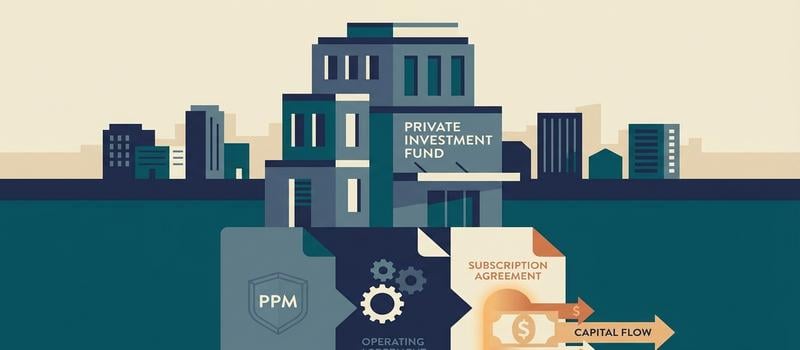
The document that actually governs the money is the Operating Agreement. It’s the contract for the LLC, and it says who gets paid, in what order, and under what conditions. The manager’s discretion, the preferred return, the promote, the timing of distributions, all of it lives there.
The PPM is a narrative explanation of what that agreement says. It walks an investor through the economics in plain language so they can understand the deal before they sign the Subscription Agreement and wire the money. The PPM describes, and the Operating Agreement controls.
Copying a sample creates a mechanical problem you can’t see until it’s too late. Say Bob finds a clean sample PPM that describes an 8% preferred return and a 70/30 split above the pref. He likes the language, so he keeps it. But his actual Operating Agreement, the one his investors are bound by, says 6% and an 80/20 split, because that’s the deal he negotiated with his equity partner.
Now his PPM and his Operating Agreement disagree with each other. He’s told his investors one set of numbers and legally committed them to another. He’s created a material misstatement, and it’s baked into the deal from day one, whether or not anyone catches it before closing.
How the Operating Agreement changes between a blind pool and a specific asset
A sample built for a blind pool fund and a sample built for a single specific asset are different documents doing different jobs, and the difference runs all the way down into the Operating Agreement, because the agreement has to govern two very different situations.
In a blind pool, the investor is trusting the sponsor’s judgment to go find deals that don’t exist yet, so the Operating Agreement has to grant the manager broad discretion to acquire, hold, and dispose of assets that aren’t identified yet, and the PPM leans heavily on the sponsor’s track record and the investment criteria. A specific asset offering runs the other way. The Operating Agreement is written around one identified asset, the manager’s authority is narrower because everyone already knows what’s being bought, and the investor can look at the actual asset and decide for themselves whether it’s a good buy. That lowers the trust hurdle, and I’d rather see a sponsor use that than hide it.
But the specific asset comes with a cost on the disclosure side that a copied document won’t carry. When the investor can evaluate the actual property, they expect the numbers that go with it: a three-year proforma tied to that asset, the appraisal, the rent roll or the operating history, the debt terms. A generic sample has none of that, because none of it existed when the sample was written, and its Operating Agreement grants discretion the sponsor of a single-asset deal doesn’t need and shouldn’t be claiming. You can copy the structure of those sections all day long and you still have empty boxes where your deal’s actual facts are supposed to go.
The Anti-Fraud Rule and the Cost of Mismatched Disclosures
Rule 10b-5 and material omissions
In practical terms, Rule 10b-5 makes it illegal to lie to an investor and equally illegal to stay silent about something the investor would have wanted to know. The second half is what catches sponsors. You don’t have to say anything false to get sued. You just have to leave out a material fact.
A material fact is anything a reasonable investor would consider in deciding whether to put money in. It’s not a fixed list. It depends on your asset, your business plan, your track record, your capital stack, and the specific things that could go wrong with this deal and not some other one. A zoning risk is material when it could sink the whole project, and a copied document written for a stabilized building says nothing about it.
Borrowing disclosures fails structurally for that reason. A sample was written to describe someone else’s deal, so it discloses someone else’s material facts. Yours are different by definition. The document can’t omit a risk it was never asked to consider, and it can’t disclose a risk it never knew existed. From the investor’s side, an omission looks the same whether it was deliberate or just copied from the wrong template, and the liability is the same either way.
When you’re actually ready to raise money, the document gets built around your deal. That’s the work in a private placement memorandum legal package: the risk factors track your specific asset, the economics match what your Operating Agreement actually says, and the disclosures cover the exemption you’re really using. A custom document is the thing that gives you a defense if an investor loses money and comes looking for someone to blame, because you disclosed the risks that mattered to your deal and let them decide with their eyes open, which keeps the loss with the investment instead of on you personally.

Tilden Moschetti, Esq., is a highly sought-after syndication attorney with nearly two decades of experience. His clientele ranges from real estate developers and startups to established businesses and private equity funds. Tilden’s expertise in syndication law comes not only from his knowledge of syndication and securities law but from real, hands-on experience as an active syndicator himself in every real estate product type and nearly all markets in the US. His knowledge and experience set him apart and established him as the Reg D legal services leader.