
The Legal Reality Behind the Three-Layer Capital Stack
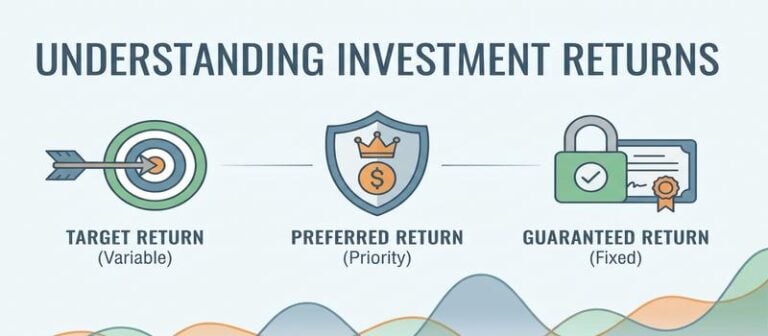
The capital stack in a development syndication is the order in which money gets repaid and losses get absorbed, running from senior debt at the top, through preferred equity in the middle, down to common equity at the bottom. That order isn’t just a payment schedule. It’s a legal hierarchy that decides who controls the project, who gets paid first when cash comes in, and who eats the loss when the deal stalls. Treat it as a spreadsheet and you’ll miss the part that actually decides whether you keep the GP seat.
Senior Debt, Preferred Equity, and Common Equity Defined
Senior debt sits at the top because it holds the first-position lien and the first claim on payment. If the project goes sideways, the senior lender forecloses, takes the asset, and gets made whole before anyone below it sees a dollar. That priority is the reason senior debt is the cheapest money in the deal, and it’s also the reason the senior lender gets to dictate terms to everyone underneath it.
Preferred equity sits in the middle. It gets paid its return before common equity sees any distribution, so it has priority over the common, but it’s still subordinate to the bank and it has no lien on the real property. If you want the mechanics of how this layer is papered inside a Reg D raise, I’ve written separately on preferred equity structures in Regulation D.
Common equity, usually the LPs and the sponsor’s co-invest, sits at the bottom in the first-loss position. If the project loses money, the common gets wiped out before the preferred or the bank takes a scratch. In exchange for standing in front of the losses, the common captures the uncapped upside, which is why it carries the highest target return. That difference in legal standing, lender versus owner, is the real line between a debt position and an equity position, and it drives everything else in the stack.
Dropping a layer of preferred equity between the senior loan and the common equity generally lowers the total annual cost of capital compared with a plain two-layer deal of debt plus common. Preferred money prices below common equity because it stands ahead of the common in the payment order and gets its return before the common sees a dollar. That priority claim is what lets it accept a lower target return, so blending it in brings the average cost down and frees up cash you can put toward the build budget or hold back as a reserve. That’s the part sponsors like.
Why the Spreadsheet Misses the Structural Risk
Cost math is where most sponsors stop. The model shows a lower blended cost and a higher LP IRR because cheaper subordinate capital replaced expensive common equity, and the deal looks better on paper, so in it goes. The problem is that every layer you add brings another institutional party with its own covenants, its own remedies, and its own idea of what happens when the project misses a date.
Senior lenders and preferred equity investors don’t hand you money and sit quietly. They negotiate for control, and that control shows up as intercreditor restrictions, draw conditions, completion guarantees, and step-in rights that can take the project away from you. Optimize purely for cost and you can end up with capital that’s cheap on the rate and expensive on the terms, which is a trade you usually can’t see in the IRR column. This is the sort of thing worth running past legal services for real estate syndication sponsors before you sign, not after.
Intercreditor Agreements and Senior Lender Control
No, a sponsor can’t just add preferred equity or mezzanine debt to fill a gap. The senior lender decides what subordinate capital is allowed to exist above it and what that capital is allowed to do, and if you bring in a new layer without the lender’s consent, you’ve probably just defaulted on the senior loan.
The capital layers don’t operate in separate boxes. They’re tied together by agreement, and the senior lender sits at the top of that structure dictating terms down the stack.
Intercreditor Agreements
An intercreditor agreement (ICA) is the contract that sets the rules of engagement between the senior lender and whatever sits below it. It spells out who gets paid first, whether the subordinate party has any right to cure a senior default, and what the subordinate party can and can’t do when the deal goes sideways. The senior lender is writing those rules to protect its first position, so the terms run in its favor.
Say Bob is building a $15 million self-storage facility. His senior construction loan covers $12 million, he’s got $1 million of common equity in, and he’s $2 million short. A mezzanine lender offers to fill the gap, and Bob figures he’ll just take it and keep the deal moving.
He can’t, at least not quietly. His senior loan documents almost certainly contain covenants that prohibit additional indebtedness and additional liens without the bank’s written consent, and bringing in a mezzanine lender violates both. So Bob’s real options are to go back to the bank, disclose the mezzanine piece, and negotiate an intercreditor agreement the bank will sign, or to fill the gap with equity instead. If he closes the mezzanine loan without telling the bank, he’s handed the bank a default it can call. I wouldn’t put a sponsor in that position for a $2 million gap.
Subordinating the Preferred Equity
What the bank is really afraid of is a subordinate party with enough leverage to blow up the bank’s remedies. A mezzanine lender or an aggressive preferred investor who can force the borrower into bankruptcy, or jump in and disrupt a foreclosure, is a direct threat to the senior lender’s ability to get its money back. So the senior lender wants that party on paper agreeing to stand down.
For preferred equity, that often takes the form of a recognition agreement, where the preferred investor acknowledges the senior loan and agrees to stay out of the lender’s way during a default. The bank wants to know that if it has to foreclose, the preferred money isn’t going to be filing bankruptcy petitions or fighting the foreclosure in court.
The remedy structure is where mezzanine debt and preferred equity actually diverge. Mezzanine debt is secured by a pledge of the entity’s equity interests, so the mezzanine lender’s remedy is a UCC foreclosure that sweeps out the borrower and takes ownership of the property-owning entity. Senior lenders scrutinize that remedy hard, because a UCC foreclosure can put a brand-new owner on top of the property while the senior loan is still outstanding. Preferred equity relies on contractual step-in rights instead of a UCC sale, which banks tend to find a little more palatable because it doesn’t change the legal ownership of the asset the same way, though the ICA still has to be drafted carefully so the step-in doesn’t trip a change-of-control default or violate a transfer covenant.
Preferred Equity Step-In Rights and Loss of Sponsor Control
Preferred equity is not quiet money that sits in the stack and collects a yield. It usually shows up with the right to take over the deal if you miss the marks you promised, which means a preferred investor can remove you as the manager and run the project without you.
How a Missed Milestone Strips the Sponsor of Control
The preferred equity documents, whether they live in the Operating Agreement or a side agreement, almost always list triggers. Miss a construction completion deadline, miss a coupon payment, blow past a cost threshold, and the investor’s remedies switch on. Those remedies typically let the preferred investor replace the manager, take the GP seat, and make every decision on the project from that point forward.
Say Bob’s building a ground-up project and the municipality sits on his permits for five months. It’s nobody’s fault, exactly, but the schedule in the preferred documents doesn’t care about fault. The milestone gets missed, the trigger fires, and now the preferred investor has stepped in.
At that point Bob doesn’t control the checkbook anymore. He can’t sit down with the general contractor and renegotiate the schedule or approve a change order, because the person writing the checks is the preferred investor’s representative, and that person’s interest is getting the preferred capital back, not protecting Bob’s promote. Bob still has his name on the completion guarantee (more on that liability in the next section), but he’s lost the ability to run the thing he’s personally on the hook for. That’s a bad place to be, and it’s the reason these triggers get negotiated hard before anybody signs.
The fix isn’t to refuse step-in rights entirely, because a real preferred investor won’t fund without some version of them. The fix is to draft the triggers so they key off things Bob can actually control, build in cure periods, and carve out delays caused by force majeure or government inaction. I’d rather see a 30-day cure right and a narrow list of triggers than a clean document that hands over the keys the first time a permit runs late.
The Risk of Debt Recharacterization
Preferred equity is called equity, but it doesn’t always behave like equity, and that gap is where the legal risk lives. When a preferred piece has a hard maturity date, a fixed mandatory return, and aggressive control rights, it starts to look a lot like a loan wearing an equity costume. A court or a taxing authority can look through the label and treat it as debt.
That recharacterization matters for two reasons. On the tax side, the distributions you treated as equity returns can get recast, which changes the math for everyone in the deal. On the loan side, your senior lender’s covenants almost certainly cap how much debt sits behind them, so if your preferred equity gets reclassified as debt, you may have just breached the senior loan without ever intending to borrow another dollar. You can read more about how these structures are set up in preferred equity structures in Regulation D, because the way you paper the return and the control rights is what determines which side of the line you land on.
Keeping preferred equity on the equity side of that line is a drafting problem, and it’s not a casual one. The Operating Agreement and the PPM have to describe the preferred position so the return is genuinely contingent on the venture’s performance rather than a disguised fixed obligation, and the control rights have to read as governance protections rather than creditor remedies. Getting those covenants right, without accidentally creating a maturity date that reads like a loan, is the kind of thing that calls for a lawyer who’s drafted these before and knows where the recharacterization risk hides.
Draw Schedules and Interest Reserves
Buying a stabilized building is simple on the funding side. You close, the money wires, you own the asset. A ground-up development doesn’t work that way. The capital enters in pieces, over months, on a schedule the senior lender controls, and that timing is where a lot of sponsors get caught off guard.
Matching Capital Calls to Construction Progress
The senior lender doesn’t hand you the loan proceeds up front. It holds the money back and releases it in draws, and each draw only gets funded after the lender’s inspector confirms that a specific piece of work is actually complete. You pour the foundation, the inspector signs off, that portion of the budget gets released. You frame the next phase, same thing again.
That creates a timing gap, because the general contractor and the subs usually want to get paid before the bank funds the draw that covers their work. Somebody has to front that money in the interim. Most of the time it’s the sponsor or the common equity carrying the cost until the draw clears, and if your subordinate capital was counting on the bank’s dollars to recycle quickly, a slow inspection can leave you short for a few weeks on costs you already owe.
The sequencing runs deeper than that. Senior lenders almost always require the equity to go in first. The sponsor’s co-invest and the common equity have to be fully deployed into the project before the bank funds its first dollar of debt. So on a $15 million deal with $5 million of equity and a $10 million loan, that $5 million is spent and in the ground before the bank is on the hook for anything. The equity is first in and first at risk, which is exactly the position it occupies in the stack.
Managing the Interest Reserve Burn Rate
A finished building generates rent. A construction site generates nothing, and yet the bank still wants its interest payments every month while you build. That money has to come from somewhere, so the loan is sized to include an interest reserve, which is basically the bank lending you the cash to pay the bank its own interest during construction.
The reserve is calculated off an assumed construction timeline. If the lender underwrote an 18-month build, the reserve holds roughly 18 months of interest. That works fine as long as the project stays on schedule.
It stops working the moment you slip. Say permitting drags, a subcontractor walks, materials show up late, and you lose six months. The building isn’t producing rent yet, but the interest clock never stopped, so the reserve that was supposed to last 18 months is now trying to cover 24. It burns out before the certificate of occupancy, and when it runs dry you’ve got a cash crunch with no obvious source of funds. At that point the sponsor is issuing a capital call, dipping into contingency, or missing a payment and tripping a covenant, and all of it traces back to a reserve that was sized for a timeline the project didn’t hold.
Cost Overruns and the Reality of Completion Guarantees
Nobody builds a project exactly on budget. Lumber moves, steel moves, the electrician you lined up walks, and six months into the job your hard costs are 20% higher than the number in the pro forma. The question is who pays for that.
Who Funds the Gap When the Budget Breaks
Senior lenders do not fund budget gaps. The bank committed to a loan amount at closing, and it isn’t going to wire you more just because concrete got expensive. The loan is capped, and the bank’s position is that the gap is your problem, not theirs.
So the money comes from somewhere below the debt. Say Bob is building that $15M self-storage facility and his materials budget blows out by $2M. His options are to put the money in himself, call it from the common equity, or try to bring in emergency subordinate capital, and that last one only works if the intercreditor agreement lets him add a layer at all, which usually it doesn’t without the senior lender’s written consent.
Most of the time the gap gets filled by a capital call to the LPs, and that’s where the Operating Agreement earns its keep. If the document is silent on what happens when an investor doesn’t answer the call, you have a fight on your hands in the middle of a construction crisis. I’d rather see the agreement spell out the dilution mechanics up front, so that an LP who sits out a call gets their percentage reduced by a formula everyone agreed to when they signed the subscription documents. The ones who do fund the call get the benefit of that dilution. Writing that cleanly is dull work, but it’s the difference between a quiet adjustment and a lawsuit.
The Sponsor’s Personal Liability Exposure
A common equity investor has limited liability and the sponsor doesn’t, and that gap is the exposure sponsors tend to forget when they’re excited about a deal. If the whole thing goes sideways, Bob’s LP who put in $250,000 loses the $250,000 and not a dollar more. The bank can’t come after that investor’s house.
The sponsor doesn’t get that protection. To close a construction loan, the GP (or its principals personally) almost always has to sign a completion guarantee, which obligates them to finish the building regardless of what it costs. If the project runs $3M over and the LPs won’t fund it, the guarantee doesn’t care. You signed to deliver a finished asset, and the bank can enforce that against you personally.
That recourse is why control matters so much to the sponsor, and why the step-in rights sitting in a preferred equity deal are more dangerous than they look on paper. If a preferred investor takes the checkbook because you missed a milestone, you’re no longer running the construction, but your completion guarantee to the senior lender is still live. You can end up personally liable to finish a building you no longer control, your net worth exposed to overruns you can’t authorize or manage, and it’s the reason I push sponsors to negotiate the step-in triggers hard before they ever sign them.
Distribution Priority at the Sponsor Level
Money leaves the project in the reverse order of who took the risk to put it there. The senior lender gets serviced first, the preferred equity takes its yield next, and the common equity gets whatever is left over.
Servicing the Senior Loan Before the Preferred Yield
Once the building is stabilized and leased up, it finally starts producing rent, and that’s the first time there’s actual operating cash to distribute instead of draws and reserves funding everything.
That cash doesn’t flow to investors first. It flows to operating expenses and senior debt service, and only what’s left after those two line items is available to move down the stack. The bank gets paid its principal and interest before a single dollar reaches a subordinate layer, because that’s the deal it wrote when it took the first lien.
Preferred equity sits next in line. Say the pref carries an 8% annual return on $3 million of invested capital. That’s $240,000 a year the preferred investor is owed out of available cash flow before common LPs see anything, and if the property throws off enough to cover debt service and the pref but not much more, the common equity can go a full year with no distribution while the preferred holder gets paid in full. The pref demands that yield precisely because of where it sits, senior to the common and junior to the bank.
The Ultimate Return to Common Equity
Common equity is at the bottom. It’s the first-loss position, which means if the project underperforms, the value erodes from the bottom up, and the common holders feel it before the pref or the lender does.
The trade for taking that position is the upside. After the senior debt is retired and the preferred has received its return, whatever profit remains on a sale or refinance flows to the common equity, and there’s no cap on it. That’s why common capital requires the highest potential return of anything in the stack, because it’s the only layer getting paid out of what’s uncertain rather than what’s contracted.
A development syndication that holds together is one where these layers are reconciled against each other in the PPM and the Operating Agreement, not just in a spreadsheet. The waterfall, the pref hurdle, the capital call mechanics, the step-in triggers, and the completion obligations all have to be drafted so they point in the same direction, and when they don’t, the sponsor is usually the one who absorbs the mismatch. The economics only behave the way the model promises if the drafting makes them behave that way.

Tilden Moschetti, Esq., is a highly sought-after syndication attorney with nearly two decades of experience. His clientele ranges from real estate developers and startups to established businesses and private equity funds. Tilden’s expertise in syndication law comes not only from his knowledge of syndication and securities law but from real, hands-on experience as an active syndicator himself in every real estate product type and nearly all markets in the US. His knowledge and experience set him apart and established him as the Reg D legal services leader.