The Short Answer: Regulation D Applies to Almost Any Legal Industry
Almost any legal business can raise capital under Regulation D. Real estate, debt funds, private equity, tech startups, manufacturing, healthcare – the exemption does not care what you do.
Here is the distinction that trips people up. The exemption is universal, but the legal documents you need to use it are not. A Regulation D offering for a debt fund and a Regulation D offering for a software company sit inside the same rule, but the paperwork inside that rule is completely different.
So the practical answer is: yes, your industry almost certainly qualifies. The harder question is how the offering documents get built around your specific business.
The Myth of the ‘Real Estate Only’ Exemption
Regulation D was not written for real estate. Real estate syndicators are just the loudest users of it.
Because so many visible Reg D deals are apartment buildings and self-storage funds, a lot of founders assume the rules were designed for property acquisitions and that everyone else is borrowing someone else’s tool. That is not how it works.
The SEC does not care whether you are buying an apartment building, launching a software company, or lending money out as a debt fund. Regulation D governs how you raise the money, not what you do with it.
As long as the underlying business is federally legal, Regulation D can serve as the primary compliance mechanism for the capital raise. That is true whether the asset is a warehouse, a loan portfolio, or a Series A round.
Why the Exemption is Universal
Rule 506 is a safe harbor. In plain English, that means it gives you a defined set of conditions, and if you meet them, your offering is exempt from full SEC registration.
Those conditions are about the transaction, not the operations. Rule 506 tells you how you can market the offering and who is allowed to invest. It does not tell you what the issuer – the company selling the securities – is supposed to do for a living.
That is why the same rule works across industries. You are selling securities, and the rule governs the sale. The fact that one issuer flips real estate and another writes code is irrelevant to whether Rule 506 applies.
The rule is standard. What has to be custom is everything you hand the investor to explain the deal.
The Core Distinction: The Exemption Envelope vs. The Legal Architecture
If Regulation D works for almost every industry, why can’t you use one set of documents? Because Rule 506 only gives you permission to raise capital. It does not tell you how to describe your business, how to manage the money, or how to protect yourself when an investor is unhappy.
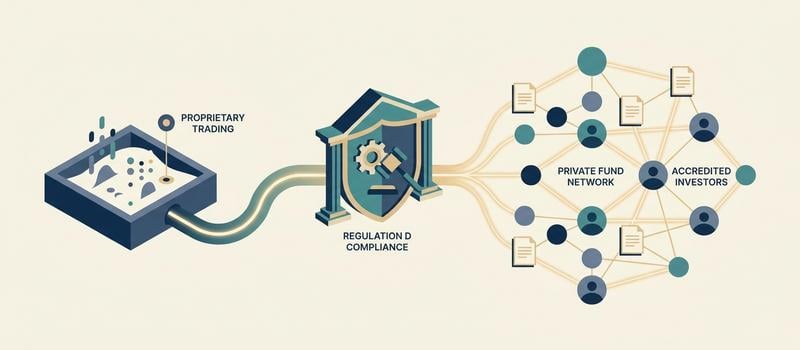
Think of Rule 506 as the envelope. The legal architecture lives inside that envelope, and it has to be built around what your business actually does. That is the part that changes from deal to deal.
The Exemption Envelope
The envelope is narrow. Regulation D sets the boundary conditions for the offering: whether you can advertise, whether you have to verify that your investors are accredited, and whether you need to file a Form D with the SEC and Blue Sky notices in the states where your investors live.
That is it. The rule governs the transaction, not the business.
Complying with the envelope is the easy part. It is a checklist. You pick 506(b) or 506(c), you follow the advertising and verification rules for that lane, and you make your filings. None of that requires you to think hard about your specific asset class.
The Internal Legal Architecture
The architecture is where the real work is. Three documents do most of the heavy lifting: the Private Placement Memorandum (PPM), the Operating Agreement or LPA, and the Subscription Agreement.
The PPM discloses the offering and the risks. The Operating Agreement defines how the money is managed, who has authority, and how returns get distributed. The Subscription Agreement controls how investors actually get into the deal.
Here is the contrast that matters. The envelope tells the SEC you are raising money legally. The architecture protects you from an investor later claiming you lied to them about the business.
That second problem is the anti-fraud problem under Rule 10b-5, and complying with the exemption does nothing to solve it. The envelope keeps you exempt. The architecture keeps you out of court.
Rule 506(b) vs. 506(c): Your Marketing Strategy Dictates the Exemption, Not Your Industry
Your industry does not tell you whether to use Rule 506(b) or Rule 506(c). That choice comes down to one thing: how you plan to find your investors.
The question is not “I’m a real estate sponsor, so which one do I use?” The question is “Do I want to advertise this offering publicly, or do I want to raise from people I already know?”
Rule 506(b): The Private Network Option
Rule 506(b) is for sponsors raising from an existing network. You cannot generally solicit, which means no public advertising, no website blasts, no pitching the deal to strangers you have no prior relationship with.
In exchange, you get flexibility on who can invest. You can take an unlimited number of accredited investors, plus up to 35 non-accredited investors who are sophisticated enough to evaluate the deal.
That last part sounds like a gift. It is not.
Taking non-accredited investors under 506(b) is not a free pass. The moment you let one non-accredited investor in, you trigger a heavy set of financial and accounting disclosure requirements, including audited financials in many cases.
That is why most sponsors who know what they are doing stick to accredited investors only, even under 506(b). The 35-person allowance is available, but the disclosure burden it creates usually is not worth it.
Rule 506(c): The Public Advertising Option
Rule 506(c) lets you advertise. You can post the offering on your website, talk about it publicly, and market it openly to people you have never met.
The tradeoff is verification. Under 506(c), every single investor must be accredited, and you must take reasonable steps to verify it. That means you cannot just take the investor’s word for it on a questionnaire.
In practice, “reasonable steps” usually means collecting a CPA letter, an attorney letter, or reviewing tax returns and bank statements. It is a real verification step, not a checkbox.
Notice that none of this depends on what your business does. A crypto startup, a real estate fund, and a manufacturing company all face the exact same choice.
Do you want to advertise, or do you want to use your private network? Answer that, and you have answered the 506(b) versus 506(c) question. Your industry has nothing to do with it.
How the PPM Changes for a Real Estate Syndication
A real estate syndication usually raises money for one specific, identified asset. The investor knows exactly what building they are buying before they wire a dollar. That single fact shapes the entire legal architecture, from the risk factors in the Private Placement Memorandum to the distribution mechanics in the Operating Agreement.
The Single-Asset Focus
Most syndications are single-asset raises. You are buying one property, and the PPM describes that one property in detail.
The money usually has to show up all at once. The equity you raise pairs with a senior bank loan, and both have to be at the closing table on the same day. You are not drawing capital down over three years – you need it funded to close.
That means the offering is fixed. The Single-Asset Issuer holds one property, the raise is sized to that property, and the whole document set is built around a known deal rather than a manager’s future discretion.
For sponsors on the operating and structuring side, this is the cleaner end of the spectrum. You can point to the actual asset, which makes the disclosure job more concrete. If you are working through how this applies to your own model, we cover it in more detail on capital for operating businesses and the real estate context specifically.
Property-Specific Disclosures
The PPM has to disclose the risks that come with the actual building. That means environmental hazards, interest rate movement on the senior loan, tenant vacancy, deferred maintenance, and whatever else is specific to that property and that market.
This is where a generic template starts to hurt you. The risks that matter here are property-level risks, and if the document does not name them, you have not disclosed them.
The Operating Agreement, in turn, focuses on Waterfall Distributions. That is the order of payment: who gets paid first from ongoing cash flow, who gets paid from a refinance or sale, and where the Sponsor’s promote sits in that stack.
In plain English, the waterfall answers a simple investor question – when the property makes money, in what order does that money come out? For a single-asset deal, that question has a clean answer, and the document should state it clearly.
How the PPM Changes for a Private Equity or Debt Fund
A private equity or debt fund flips the funding model. Investors commit capital before the assets are identified, so the PPM has to govern capital calls, the investment mandate, and manager discretion instead of the metrics of one specific property.
This is where a fund raise looks nothing like a real estate syndication, even though both live inside the same Rule 506 envelope. If you want the deeper mechanics of running a pooled vehicle, we cover them in raising a private equity fund under Reg D.
The Blind-Pool Dynamic
A blind-pool fund asks investors to evaluate the sponsor and the strategy before all the assets exist. They are not buying a building they can drive past. They are buying the fund manager’s thesis and underwriting ability.
That changes what the PPM has to do. It cannot describe one asset, because there is no asset yet. Instead, it has to describe the kind of assets the manager is allowed to acquire.
That is the Investment Mandate, and it usually gets negotiated hard. The mandate defines what the manager can and cannot buy – asset type, geography, leverage limits, concentration limits, and anything else that keeps the manager inside the lane investors agreed to.
From the investor’s point of view, the mandate is the substitute for the asset. It is the promise about what their money will and will not chase. Draft it too narrow and you box yourself in. Draft it too broad and investors will not trust you with the discretion. Getting that balance right is the whole game.
Capital Calls and Recycling
Funds usually draw money over time rather than all at once. In a real estate deal, the money comes in at closing to pair with senior debt. In a fund, investors sign a capital commitment, and the manager draws it down through capital calls as deals get done.
That creates two problems the Operating Agreement has to solve. First, what happens when an investor does not fund a capital call. You need real penalties on paper – dilution, forfeiture, interest, forced sale of the defaulting investor’s interest – or the whole commitment structure is just a suggestion.
Second, whether the manager can recycle capital. If the fund sells an asset early and returns proceeds, can the manager pull that money back in and invest it again, or does it have to be distributed. That is a real economic decision, and it belongs in the Operating Agreement, not in a conversation after the money is in.
If your fund documents borrow their distribution and default language from a single-asset syndication template, none of this will be there. And in a blind-pool fund, that is exactly the language investors and their lawyers read first.
How the PPM Changes for an Operating Business or Tech Startup
Yes, an operating company can raise expansion capital under Reg D. Same exemption, same Form D, same 506(b) or 506(c) choice. But the risk story is completely different, because you are not selling an asset. You are selling the odds that your business actually works.
Real estate has a building. A debt fund has loans. An operating company has execution risk – the chance that the plan fails even when the idea is good. The PPM has to say that plainly.
Selling Growth Instead of Yield
An operating business is usually selling equity growth, not yield. There is no quarterly distribution from rent or interest payments. The investor is betting on the company being worth more later.
The documents have to say that outright. There may be no distributions for years. There may be no distributions ever. The investor’s return depends on a sale, a recapitalization, or some other liquidity event that may never come.
This is where founders get sloppy. They borrow a real estate or debt-fund PPM, and it implies a steady payout that the operating business cannot support. Now the disclosure contradicts the business, and you have created a problem you do not need.
If it were me, I would state the liquidity reality bluntly and early. Investors who want yield should not be in this deal, and the PPM should make sure they know it before they sign.
Disclosing Execution and Key Person Risk
The real estate PPM talks about interest rates, vacancy, and the senior loan. None of that is your risk. Your risk is a competitor with more funding, a technology shift that makes your product obsolete, a supply chain that breaks, or a longer runway to profitability than you promised.
Then there is Key Person Reliance. In most early operating companies, the founder is the company. If the founder leaves, gets sick, or gets hit by a bus, the investment can collapse. That risk has to be disclosed, and the Operating Agreement should address what happens to control and management if the founder is gone.
Here is the practical consequence. If your PPM reads like a real estate document, it is not just a bad fit – it is materially deficient. You disclosed the wrong risks and stayed silent on the ones that actually matter, which is exactly the kind of omission that gets a sponsor into trouble.
Start with how your business actually makes money and how it can fail. Draft the risk section around that reality, not around a template written for a different asset class.
The Trap of the Generic PPM Template
Grabbing a real estate PPM template and swapping in your company name is the fastest way to build a legally deficient offering. The problem is not the exemption. The problem is that the template discloses someone else’s risks, not yours, and that gap is exactly what plaintiffs and regulators look for.
Rule 506 gets you the exemption. It does not get you out of anti-fraud liability.
The Anti-Fraud Mandate
Even if you perfectly comply with Rule 506(b) or 506(c), you are still fully subject to Rule 10b-5, the federal anti-fraud provision. That rule does not care that you followed the exemption to the letter.
Rule 10b-5 covers two things: lying to investors, and leaving out something they needed to know. That second one is the “material omission,” and it is where generic templates fail.
If your business faces a real risk – key person dependence, a regulatory approval you have not obtained, customer concentration – and your PPM does not disclose it because the template you bought did not include it, that is a material omission. The fact that you copied it in good faith is not a defense.
The consequence is rescission risk. An investor who can point to an omitted material risk may be able to unwind the deal and demand their money back, often at the worst possible time for the venture.
Structuring for Your Reality
Start with how your business actually works. How does it make money, what has to go right, and what are the specific ways it can fail?
Write those down honestly before anyone drafts a document. The PPM, Operating Agreement, and subscription documents should wrap around that reality, not the other way around.
If it were me, I would never let the template drive the disclosure. The disclosure should come from the business, and the documents should follow.
If your model does not fit the standard real estate, fund, or operating-company patterns – a crypto venture, a hybrid structure, a novel asset class – that is exactly when a template does the most damage. Those are the deals worth getting legal services for non-standard Reg D offerings so the disclosures actually match what you are selling.

Tilden Moschetti, Esq., is a highly sought-after syndication attorney with nearly two decades of experience. His clientele ranges from real estate developers and startups to established businesses and private equity funds. Tilden’s expertise in syndication law comes not only from his knowledge of syndication and securities law but from real, hands-on experience as an active syndicator himself in every real estate product type and nearly all markets in the US. His knowledge and experience set him apart and established him as the Reg D legal services leader.