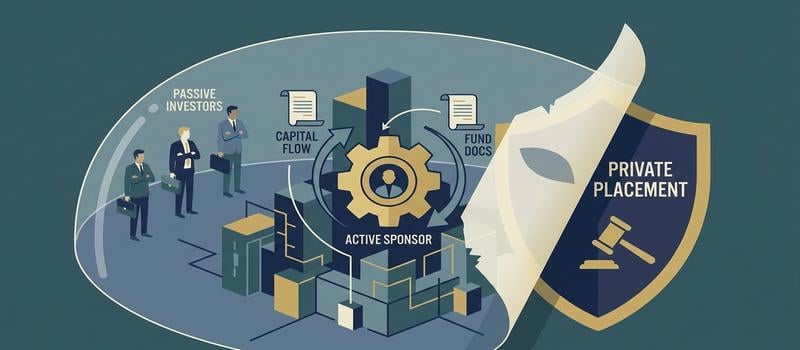
The Short Answer: A Syndication Is Two Simultaneous Transactions
Syndicating real estate is two deals happening at once. You are buying a building, and you are running a regulated securities offering to raise the money to buy it. Most people only think about the first one.
The casual version in a sponsor’s head is “I’ll pool some money and buy a property.” That’s not wrong, but it hides the part that gets people in trouble. When you take money from passive investors and they are relying on you to make it work, you are selling a security. That means the SEC’s rules apply, whether or not you meant to trigger them.
So the framework is this. There are two entities and two sets of documents. The real estate syndication itself – the property purchase – runs on one track. The securities offering runs on the other. Both have to get to the closing table at the same time.
The Real Estate Track vs. The Legal Track
The real estate track is the part sponsors already understand. You sign a Letter of Intent, negotiate the Purchase and Sale Agreement, run your due diligence, and close on the asset. That’s the normal work of buying a building.
The legal track is the part sponsors underestimate. You form the entities, pick your Regulation D exemption, draft the Private Placement Memorandum, and collect signed subscription documents from your investors. That is the securities offering, and it takes real time to build.
Here is the point that matters. These two tracks run at the same time, not one after the other. You cannot close the property and then figure out the legal side, because you need investor money at closing, and you cannot legally take that money until the offering is built. You also cannot finish the legal side first, because the offering is describing a specific property under contract.
If it were me, I’d treat the day you sign the LOI as the day both clocks start.
The Trap of “Testing the Waters”
The most common timing mistake is pitching the deal to investors before the legal architecture exists. The sponsor wants to “see if the money is there” before spending anything on documents. I understand the instinct. It creates a problem you do not need.
The problem is that talking to investors about a specific deal is part of the securities offering. If you do it before you’ve picked an exemption and put the right disclosures in place, you can blow the exemption before you’ve even filed anything. Under Rule 506(b), for example, casual outreach to people you don’t have a real relationship with can look like general solicitation, and general solicitation is not allowed under that rule.
So the practical answer is to start the legal conversation the moment the LOI is signed, not after you’ve lined up soft commitments. You want the exemption chosen and the offering structure decided before you start showing the deal around. Once that’s in place, you can talk to investors inside the lines instead of hoping you didn’t step over one.
Phase 1: Locking Up the Asset and Triggering the Timeline
The moment you sign the Letter of Intent (LOI) on a property, your capital raise clock starts running. That is the practical answer to when you engage securities counsel: now, not after you have found the money.
The LOI and later the Purchase and Sale Agreement (PSA) set the outside date for everything on the legal track. Whatever closing window you negotiate with the seller is the same window you have to form entities, pick your exemption, draft the disclosure documents, and actually collect wires from investors.
So the real estate timeline is not just a real estate issue. It is the constraint on your entire securities offering.
Negotiating the PSA for a Syndication
Buying for a syndication is not like buying for yourself. When you buy for your own account, a 30-day close is fine because the only thing standing between you and the closing table is your own money and your own financing.
A syndication adds two steps that take real time: building the legal documents and raising the money from other people. Neither of those happens in 30 days.
You need time to form the entities, prepare the Private Placement Memorandum and subscription documents, put the deal in front of investors, and give them enough runway to review and wire. Sixty to ninety days is a realistic PSA closing window for most single-asset raises. Shorter than that and you are forcing the legal work and the capital raise into a box they do not fit into.
If it were me, I would negotiate that timeline into the PSA up front rather than assuming you can extend later. Extensions cost money or goodwill with the seller, and sometimes both.
Single-Asset vs. Blind-Pool Fund
This guide is about syndicating a specific, identified property that is already under contract. You know the address, you have an LOI or PSA, and you are raising money to buy that one asset.
That is different from a blind-pool real estate fund, where you raise capital first and buy assets later under an investment mandate. In a fund, there is no specific property to disclose on day one, so investors are evaluating you and your strategy instead of a known deal.
The timing mechanics change in a fund because the PSA clock does not drive your raise the same way. Everything below assumes the single-asset structure, where the property and its closing date set the schedule.
Phase 2: The Dual Operating Agreement Framework
A real syndication uses two entities, not one. You need a Management Entity that holds the sponsor team, and a separate Investment Entity that holds the investors and buys the property.
The mistake I see most often is trying to put everyone inside a single LLC. That creates a problem you do not need. Your co-sponsors and your passive investors do not belong in the same document, and they do not have the same rights.
Keep them separate from the start. The Management Entity governs your side. The Investment Entity governs the deal the investors are buying into.
The Management Entity (GP-Level)
The Management Entity is the company owned strictly by the active sponsors – the people actually doing the work. This is your house, not the investors’ house.
Its Operating Agreement handles the internal sponsor questions. Who owns what percentage of the promote. How that equity vests if a co-sponsor walks after month three. Who signs, who decides, and what happens when two of you disagree.
None of that is investor business. Passive investors should never have access to this document, and they should never have voting rights inside it. If a co-founder leaves and you have to renegotiate the split, that is a conversation among the sponsors – not something that reopens the deal for every investor.
Think of the Management Entity as the general partner. It is the entity that will manage the Investment Entity below it.
The Investment Entity (The Issuer)
The Investment Entity is where the money goes. This is the LLC or LP that pools investor capital and actually buys the property. It is the issuer of the securities, and it is the entity investors are subscribing into.
Its governing document – the Operating Agreement if it is an LLC, or the Limited Partnership Agreement if it is an LP – sets the economics investors care about. The preferred return. The distribution waterfall. The limited voting rights they get, which are usually narrow: major decisions, removal for cause, and not much else.
The Management Entity sits on top as the manager or general partner. In plain English: your sponsor company runs the Investment Entity, and the investors are along for the economics without controlling day-to-day decisions.
That separation is the point. Investors get a clear document that tells them exactly what they bought. You get a separate document that governs your team without exposing your internal splits and disputes to fifty limited partners.
Keep the two documents consistent with each other. The promote you negotiated internally in the Management Entity has to match the waterfall math in the Investment Entity, or you have a problem waiting to surface at the first distribution.
Phase 3: Selecting Your Regulation D Exemption
You take money from investors without registering with the SEC by using an exemption. For almost every syndication, that exemption is Regulation D—and within Regulation D, you are choosing between Rule 506(b) and Rule 506(c).
The two rules solve the same problem in different ways. One limits how you find investors. The other limits how you verify them. You cannot mix and match once the offering starts, so this is a decision you make before you talk to a single investor.
Rule 506(b): The Pre-Existing Relationship Route
Rule 506(b) lets you raise an unlimited amount of capital, but it prohibits general solicitation. In plain English, you cannot advertise the deal. No posting it on your website, no LinkedIn pitch, no email blast to a purchased list.
To offer a 506(b) deal to someone, you need a pre-existing substantive relationship with that person before you present the offering. “Substantive” means you actually know enough about their finances and sophistication to evaluate whether the investment fits. Meeting someone at a conference last week and pitching them the next day does not count.
The tradeoff is on the sales side. Under 506(b), investors can self-certify their accredited status. They fill out the Investor Questionnaire and represent that they qualify, and you can generally rely on that representation absent red flags. You do not have to collect their tax returns.
So 506(b) is easier on verification and harder on marketing. If your capital comes from people you already know, this is usually the right tool.
Rule 506(c): The Mandatory Verification Route
Rule 506(c) lets you generally solicit. You can advertise the offering on a website, on social media, in a webinar, or to a cold list. That is the whole point of the rule.
The tradeoff is strict, and this is where sponsors get into trouble. Every single investor must be accredited, and self-certification is not enough. You, as the sponsor, must take reasonable steps to independently verify accredited status—reviewing tax returns, bank and brokerage statements, or getting a written confirmation from the investor’s CPA, attorney, or a third-party verification service.
The verification burden does not disappear because you built a slick sales funnel. A landing page and an intake form still leave you responsible for proving each investor was accredited. If you skip that step, you have blown the 506(c) exemption, and general solicitation means you cannot fall back to 506(b) either.
The practical rule of thumb: use 506(b) when you are raising from your own network, and use 506(c) when you genuinely need to advertise to strangers. Picking the wrong one is one of the more expensive mistakes in this process, so this is a decision worth confirming with counsel before you start marketing.
Phase 4: Building the Private Placement Memorandum (PPM)
Once your entities are formed and you have picked your exemption, you build the document that actually explains the deal to investors. That is the Private Placement Memorandum, and it does most of the heavy lifting on the legal track.
Whether a PPM is strictly required depends on your investor mix and the facts. But even when it is not strictly required, it is usually central to your disclosure record. So the practical answer is that you almost always want one.
Why the PPM Is Your Anti-Fraud Armor
A lot of sponsors think that if they only take accredited investors, they can skip the PPM and save the drafting cost. That is a mistake.
The technical rule under Rule 506(b) is that you do not have to hand a formal disclosure document to accredited investors. If your raise is all-accredited, the specific PPM mandate does not kick in.
But that is not the rule that gets sponsors in trouble. Rule 10b-5 does. It makes it illegal to make a material misstatement or to leave out a material fact in connection with the sale of a security.
Rule 10b-5 applies no matter which exemption you use and no matter how wealthy your investors are. Accredited status does not give you a pass on fraud.
That is the real function of the PPM. It is the place where you disclose the risks – the real estate risks, the market risks, the financing risks, the structural risks, the conflicts of interest, and the fact that investors can lose their money.
When you disclose a risk clearly and it later happens, the investor knew about it going in. When you stay silent to make the deal look cleaner, you are carrying the risk yourself. The PPM moves that risk onto the investor who read it and signed anyway.
This is why I would not treat the PPM as an optional line item. It is the written record of what you told people before they wired money. If there is ever a dispute, that record is what you have.
This is the point in the process where you engage securities counsel to draft the disclosure package. This is also where sponsors bring in legal services for real estate syndication sponsors to build the PPM, the operating agreement, and the subscription documents as one consistent set.
The Subscription Documents
The PPM tells the investor about the deal. The Subscription Agreement is how the investor actually gets in.
The Subscription Agreement is the contract where the investor agrees to buy a specific number of units in the Investment Entity for a specific amount of money. It is the binding purchase document, and it references the terms in the operating agreement or LPA.
Attached to it is the Investor Questionnaire. This is where the investor represents their accredited status and gives you the information you need to confirm they are a suitable purchaser.
Under 506(b), the questionnaire is where accredited investors self-certify. Under 506(c), the questionnaire supports your file, but it is not enough on its own – you still have to take reasonable verification steps, which is a separate obligation.
Keep these documents consistent with each other. The units and price in the Subscription Agreement, the economics in the operating agreement, and the risks in the PPM all have to line up. When they do not, that gap is exactly what a plaintiff’s lawyer points to later.
Phase 5: The Capital Raise and Closing
Once the legal architecture is built, the closing phase is mostly mechanical. You collect signatures, wire investor funds into the syndication account, close on the property, and file your Form D with the SEC. The order matters, and so does staying inside the documents you already drafted.
Collecting Funds and Executing the Documents
Each investor reviews the PPM, signs the Subscription Agreement, completes the Investor Questionnaire, and wires funds directly to the Investment Entity’s bank account.
That account belongs to the issuer – the LLC or LP that will actually buy the property. It is not your management entity’s account, and it is not your personal account. Keep the money where the documents say it goes.
One boundary matters here more than any other. Do not use the closing conversation to make promises that are not in the documents.
If an investor calls and asks whether they are “guaranteed” a certain return, the answer is no, and you point them back to the PPM. Do not verbally sweeten the deal. Do not talk about easy passive income or a specific yield you did not disclose in writing.
The reason is simple. Everything you say in the sales process becomes part of the disclosure record, whether you intended it or not. If your verbal pitch is more optimistic than your PPM, you have just created a mismatch that an unhappy investor can point to later.
Stick to the terms. If the terms are good, they will speak for themselves.
Filing the SEC Form D
Regulation D requires the issuer to file a Form D with the SEC within 15 days of the first sale of securities.
The “first sale” clock starts when your first investor signs and becomes bound, not when you close on the building. So calendar it early. This is a short electronic filing, but it is not optional, and missing it can complicate future raises.
You will also have state-level “Blue Sky” filings to handle. These depend on where your investors live, not where the property sits. If you have investors in five states, you generally have notice filings and fees in five states.
Once the funds are in and the Form D is filed, you close the real estate purchase using the pooled capital. The Investment Entity is the buyer of record, the sponsor entity manages it, and the investors hold their interests in the issuer.
That is the full loop. The physical property and the securities offering close in coordination, exactly as they were built to.

Tilden Moschetti, Esq., is a highly sought-after syndication attorney with nearly two decades of experience. His clientele ranges from real estate developers and startups to established businesses and private equity funds. Tilden’s expertise in syndication law comes not only from his knowledge of syndication and securities law but from real, hands-on experience as an active syndicator himself in every real estate product type and nearly all markets in the US. His knowledge and experience set him apart and established him as the Reg D legal services leader.