The Actual Job of a Private Placement Memorandum
A Private Placement Memorandum does not sell your deal. Its real job is disclosure – it explains the risks, the terms, and the mechanics of the offering to an investor before that investor writes a check.
Sponsors often think of the PPM as a fundraising document. It isn’t. It’s the document that protects you when an investor later claims they didn’t understand what they were getting into.
The core mechanics of the PPM are simpler than most people assume. If you want the full breakdown of how the document is built, we’ve covered the core mechanics of a PPM separately.
What a PPM Does (and Does Not) Do
The PPM is the central disclosure document for your offering. It lays out the terms of the deal, how the manager gets paid, and the specific risks an investor is taking – in plain English, not buried in defined terms.
That’s the “does” part. Here’s the “does not” part.
It is not a marketing brochure. It is not designed to make investors excited, and it is not designed to make your raise go faster. If anything, a good PPM slows the investor down and makes them read the parts they’d rather skip.
What it does for you is act as a legal shield. When you disclose a risk clearly, you’ve done your job on that risk. An investor who reads it and invests anyway cannot credibly say later that nobody told them.
The Pre-Emptive Defense Mechanism
The PPM is written for the day the deal goes sideways, not the day you close.
When a deal loses money, investors look for someone to blame. The first question their attorney asks is: what did the sponsor tell them, and what did the sponsor leave out?
The PPM answers that question in writing. It documents that the investor knew the specific risks of this deal – the illiquidity, the market exposure, the reliance on the sponsor – before they committed a dollar.
Verbal conversations don’t do this. A phone call you remember one way and the investor remembers another way is not a defense. A signed record that they received and reviewed the risk disclosures is.
The Operational Anchor for Closing Capital
On a practical level, the PPM pulls every deal term into one place.
Instead of scattering the economics across emails, a pitch deck, and a term sheet, the PPM consolidates the structure, the fees, the distribution mechanics, and the risks into a single document an investor can actually read.
That clarity matters when an investor is deciding whether to commit. A serious investor wants one authoritative source that explains the deal, not a pile of fragments they have to reconcile themselves. The PPM is that source.
The SEC Mandate: When a Disclosure Document Is Strictly Required
There is one place where federal law stops being suggestive and gets specific: the moment you let an unaccredited investor into a Rule 506(b) offering. At that point, the SEC tells you exactly what you have to hand over, and it is a lot.
If your offering is limited strictly to accredited investors, the SEC does not prescribe a specific list of disclosures. That does not mean you skip the PPM, but that is a different problem I will get to in the next section.
Rule 506(b) and the Unaccredited Investor Trigger
Under Rule 506(b), you can bring in up to 35 non-accredited investors, as long as each one is sophisticated. The moment you do, SEC Rule 502(b) kicks in and requires you to give those investors specific information about the offering.
This is not a light disclosure obligation. The information requirements are keyed to the size of the offering, and for larger raises they push you toward roughly the same financial and non-financial disclosures you would provide in a registered public offering – audited financials, a description of the business, the use of proceeds, the risk factors, the manager’s compensation, and the material terms of the deal.
In practice, there is no clean way to satisfy Rule 502(b) without producing a formal disclosure document. So while the rule technically says “provide this information,” the real-world answer is that you are writing a PPM.
And one more practical point: Rule 502(b) says every accredited investor in that same offering gets the opportunity to receive the same information. So once one unaccredited investor is in, the disclosure package effectively covers the whole raise.
The Accredited-Only Exemption Myth
Here is where sponsors get themselves into trouble. If you limit your offering strictly to accredited investors – whether under Rule 506(b) or Rule 506(c) – the SEC does not impose the Rule 502(b) information requirements at all.
Sponsors read that online, see “no prescribed disclosures required,” and conclude they can skip the PPM to save money.
That reading is technically correct and practically dangerous. The absence of a prescribed disclosure list is not the absence of a disclosure obligation. The anti-fraud rules still apply to every private offering, accredited or not, and that is where skipping the document turns into real exposure.
Rule 10b-5: Why Accredited-Only Offerings Still Require a PPM
Even when no exemption strictly requires a formal disclosure document, every private offering is still subject to the federal anti-fraud rules under Rule 10b-5. That rule does not care whether your investors are accredited. So the fact that the SEC does not prescribe specific information for an accredited-only deal does not mean you are off the hook.
This is where sponsors who skipped the PPM to save money find the real cost.
The General Anti-Fraud Standard
Rule 10b-5 makes it illegal to omit a material fact that an investor needs to make an informed decision. In plain English, you cannot leave out something important, even if you never said anything false.
That standard applies to your accredited investors just as much as your unaccredited ones. There is no carve-out because someone has a high net worth.
The problem is proof. If you rely on verbal conversations and a pitch deck, you have no record of what you actually disclosed about the risks of the deal.
When the deal is going well, nobody asks. When it goes badly, the question becomes what the investor was told and what they were not told. A well-drafted PPM is your record that the specific risks were on the table before the check cleared.
So even when a PPM is not strictly required, it is usually the center of your disclosure record. That is the practical reason it stays in the package regardless of investor mix.
The “Accredited In Name Only” Litigation Trap
Under Rule 506(b), sponsors often accept a verbal or checkbox assurance that an investor is accredited and move on. That is common, and in a good deal it never causes a problem.
The problem shows up when the deal fails and a plaintiff’s attorney starts pulling the file apart.
The first thing that attorney attacks is the accredited status. If your investor is later deemed unaccredited, and you provided no disclosure document, you have a much bigger problem than a bad investment.
Under Rule 502(b), an unaccredited investor in a 506(b) deal was supposed to receive specified information. If that investor turns out to be unaccredited and got nothing, you may lose the exemption for the whole offering. Now the securities were unregistered, and you are exposed on that ground on top of the fraud claim.
Rule 506(c) does not save you here, because 506(c) requires you to verify accreditation, not just accept a representation. If you did not verify, you were never in 506(c) to begin with.
The PPM does not fix a blown accreditation call by itself. But having disclosed the material risks in writing removes the second, larger problem – the argument that the investor was kept in the dark. That is worth far more than the drafting cost you saved.
Your Pitch Deck Is Not a Substitute for a Legal Document
No, you cannot use your pitch deck to satisfy your disclosure obligations. A pitch deck sells the upside. A PPM discloses the downside. They do two different jobs, and one does not cover for the other.
The pitch deck exists to get an investor interested. The PPM exists to make sure that same investor cannot later claim they did not know what they were getting into.
Upside Marketing vs. Downside Disclosure
The pitch deck is a sales tool. It highlights the target return, the quality of the assets, the strength of the market, and the sponsor’s track record and vision. Its job is to make someone want to keep talking.
The PPM points the other direction. It spells out the market risks, the illiquidity, the possibility of loss, the conflicts of interest, and the sponsor’s exact fee structure – the parts an investor needs to see before writing a check.
Both are legitimate. The mistake is thinking that because the deck already covers the deal, the PPM is redundant. The deck covers the reasons to invest. The PPM covers the reasons the investment could go wrong. Rule 10b-5 cares about the second one.
The Danger of Merging the Two
Stapling a few disclaimer slides to the back of a pitch deck does not solve the problem. A boilerplate legend that says “this is not an offer” and “consult your advisors” is not a disclosure of the specific, material risks in your deal. It is decoration.
The reverse mistake is just as common. Sponsors sometimes load the PPM with hype – projected returns front and center, risk factors softened into near-nothing.
That undermines the one thing the PPM is supposed to do. A document that reads like a sales brochure is a weak record when an investor’s attorney argues you buried the risks. If the PPM sells instead of discloses, you have lost the protection you paid for.
Keep the two documents in their lanes. Sell in the deck. Disclose in the PPM. And make sure what the deck promises does not contradict what the PPM discloses, because a plaintiff’s attorney will read both side by side.
How the PPM Fits Into Your Complete Legal Package
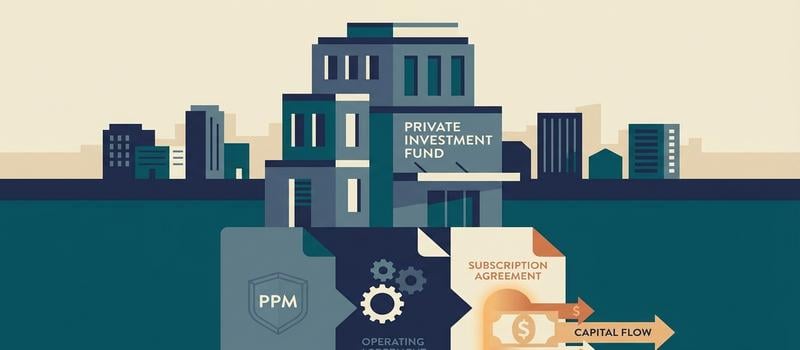
The PPM does not replace your Operating Agreement or your Subscription Agreement. It sits in the middle of them and explains what they do. Think of the PPM as the document that discloses the deal, while the other documents actually create and execute it.
Sponsors sometimes assume the PPM is the deal. It is not. The PPM is the narrator. The legal rights live somewhere else.
The Explanatory Hub
The PPM’s job is to take the dense mechanics of your structure and explain them to the investor in plain English.
Your entity has a distribution waterfall, a management structure, fee terms, and voting rights. Most of that lives in the Operating Agreement, and most investors will not read the Operating Agreement line by line. The PPM is where you summarize those terms and disclose the risks around them so the investor understands what they are buying.
That is why the documents have to agree with each other. If the PPM says one thing about the waterfall and the Operating Agreement says another, you have created a disclosure problem. Drafting a cohesive private placement memorandum legal package is largely about making sure your disclosures match your governing rules.
The Operating Agreement Sets the Rules
The Operating Agreement (or the Limited Partnership Agreement, if you are running an LP) is the document that actually creates the legal rules. It defines who manages the entity, how voting works, and how money flows through the distribution waterfall.
The PPM only summarizes those rules. It does not control them.
This matters in a conflict. If an investor points to a sentence in the PPM and the Operating Agreement says something different, the Operating Agreement generally controls. The PPM describes the deal. The Operating Agreement is the deal. Keep them consistent so you never have to find out which one a court favors.
The Subscription Documents Are How Investors Enter
Investors do not sign the PPM. They read it. When they decide to commit, they sign the Subscription Agreement to actually purchase their units.
The Subscription Agreement is the entry point. It is where the investor makes representations, agrees to the terms, and legally buys in.
The Investor Questionnaire works alongside the subscription package. It is where you gather the information to confirm accreditation and suitability. In a 506(c) offering, that verification standard is higher, and the questionnaire is part of how you build that record.
Together, the PPM, the Operating Agreement, the Subscription Agreement, and the Investor Questionnaire form one package. Each one has a distinct job, and the raise works when they line up. The PPM discloses, the Operating Agreement governs, the subscription documents admit the investor, and the Form D and any Blue Sky filings handle the regulatory side.
The Danger of Copying SEC Edgar Filings
You can find real PPMs on SEC Edgar and other public databases, and it is tempting to grab one, swap in your names and numbers, and call it done. I would not do that. You are not saving money – you are inheriting someone else’s risk profile, someone else’s state law legends, and sometimes a regulatory framework that has nothing to do with your deal.
Why Other People’s Disclosures Fail You
The risk factors are the whole point of the document, and they are deal-specific.
A tech startup’s risks – burn rate, dilution in the next round, key-person dependence on a founder – do nothing to protect a real estate debt fund. A debt fund’s risks – borrower default, lien priority, refinancing exposure – do nothing for the startup. If you copy the wrong risk section, you have disclosed the wrong things and stayed silent on the risks that actually apply to you. That silence is exactly what Rule 10b-5 punishes.
The Blue Sky legends have the same problem. State securities notices and legends change, and the ones sitting in a three-year-old filing may be outdated or aimed at states you are not even selling into. Copying them means you are relying on another sponsor’s state analysis instead of doing your own.
Your disclosure has to match your assets, your terms, your fee structure, and your states. A document built for a different deal cannot do that no matter how professional it looks.
Independent Issuers vs. Broker-Dealer Rules
A lot of the PPM guidance online is written for broker-dealers, not for independent sponsors, and that distinction matters.
If you are a licensed broker-dealer selling the offering, you have FINRA rules to deal with, including filing your offering materials under FINRA’s corporate financing rules. Those are strict, and a BD’s PPM is often built to satisfy them.
If you are an independent issuer raising your own capital under Regulation D, you are not in that world. You file a Form D with the SEC after your first sale and handle your state notice filings, but you are not filing your PPM with FINRA. Copy a broker-dealer’s document and you import structure and language built for a compliance regime you are not subject to. That does not make your raise safer. It just makes it more complicated than it needs to be.
The practical takeaway is simple. The PPM is a disclosure record, and a disclosure record only works if it describes your deal. Templates from a database describe someone else’s.

Tilden Moschetti, Esq., is a highly sought-after syndication attorney with nearly two decades of experience. His clientele ranges from real estate developers and startups to established businesses and private equity funds. Tilden’s expertise in syndication law comes not only from his knowledge of syndication and securities law but from real, hands-on experience as an active syndicator himself in every real estate product type and nearly all markets in the US. His knowledge and experience set him apart and established him as the Reg D legal services leader.