What Exactly Is a Private Placement Memorandum?
A Private Placement Memorandum, or PPM, is the disclosure document you give to potential investors that tells them the truth about the offering – what the deal is, how their money will be used, and everything that could go wrong.
It is not a marketing brochure. It is not the document that makes your deal legal. It is the record where you disclose the material facts, so that later, nobody can say you hid the ball.
That distinction matters more than most sponsors realize. So let’s define the PPM precisely and then place it where it actually sits inside the deal.
What Goes Inside a PPM
The PPM is where the sponsor explains the offering to the investor in one place.
It describes the issuer, the business plan, the fees, the manager’s conflicts of interest, how the money moves, and – the part sponsors want to skip – the risk factors. If there is a realistic way an investor could lose money, the PPM says so.
You write a PPM to protect yourself. A well-drafted PPM builds a formal record that you told the investor the material facts before they wrote the check. That record is your defense if an investor later claims they were misled.
And a PPM does not work alone. It is one piece of a full legal package.
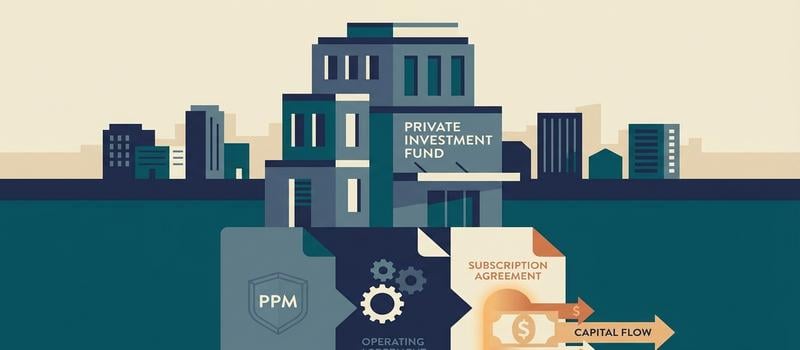
Three documents do three different jobs. The PPM discloses the offering. The Operating Agreement or LPA governs the entity. The Subscription Agreement is how the investor actually commits. You also need the Investor Questionnaire, the Form D filing, and Blue Sky support to round it out.
A PPM by itself does not make your offering legal. It supports the legal package. When people say a PPM “ensures compliance,” they are describing something a single document cannot do.
The Practical Benefit: An Operational Closing Tool
Beyond disclosure, the PPM forces your deal to become real.
You cannot draft a PPM full of vague ideas. Writing the final version makes you commit to concrete terms – the preferred return, the fee structure, the minimum investment, the use of proceeds. Fuzzy deal points get resolved because the document will not let you leave them fuzzy.
That is useful. In the real world, the PPM becomes the authoritative document investors point to when they are deciding. It is the anchor. When someone asks a question about the deal, the answer is: look at the PPM.
A Pitch Deck Is for Marketing; The PPM Is for Reality
A pitch deck sells the upside. The PPM tells the investor what the deal actually is, how it works, and what could go wrong. They are not two versions of the same document. They do two different jobs, and confusing them creates a disclosure problem you do not need.
The Problem with ‘Selling’ in a Legal Document
A pitch deck is a sales tool. It highlights the targeted IRR, the market thesis, the sponsor’s track record, and the reasons this looks like a good opportunity. That is fine. That is what a pitch deck is for.
The PPM does the opposite work. It strips out the optimism and lays out the mechanics, the fees, the manager’s conflicts of interest, and the risk factors. It is dry on purpose.
The reason it is dry matters. The PPM’s value comes from the fact that it discloses the bad along with the good. That is what supports the legal package against an anti-fraud claim – the record shows you told the investor the risks in plain terms.
When a sponsor pastes marketing copy into the PPM, that protective value drops. Now you have optimistic projections and promotional language sitting inside the document that is supposed to be your neutral, complete disclosure. That gives an unhappy investor something to point at later.
Keep the selling in the deck. Keep the disclosure in the PPM.
Which Document Does the Investor Actually Rely On?
A well-drafted PPM says the investor must rely on the PPM, not the pitch deck or any oral statements, when the two conflict. The PPM controls.
That language exists for a practical reason. A pitch deck might show a targeted 18% IRR. If the deal returns 9%, an investor may argue they were misled by the projection.
The controlling-document language addresses that. It says the deck was marketing, the PPM was the disclosure, and the PPM already told the investor that projections are estimates and returns are not guaranteed. That is a much stronger position than trying to defend an aggressive slide after the fact.
So the sequence matters. The deck opens the door and gets the investor interested. The PPM is the document you want them relying on when they actually decide to invest.
The PPM Explains the Deal, But the Operating Agreement Governs It
The PPM describes the deal. The Operating Agreement controls it. Those are two different jobs, and people who call the PPM the “official rulebook” have it wrong.
Disclosure vs. Governance
The PPM is descriptive, not operative. It explains and discloses the deal; it does not govern the entity or create the rules it describes.
The Operating Agreement – or the Limited Partnership Agreement if you are using an LP – is the legally binding rulebook for the issuer. It dictates voting rights, the distribution waterfall, capital call mechanics, and how and when a manager can be removed. The PPM takes those rules and summarizes them in plain English so the investor understands what they are actually buying. It does not create them.
The Danger of Contradiction
Here is where sponsors get hurt. If the PPM tells investors they get an 8% preferred return, but the waterfall in the Operating Agreement is drafted differently, you have created a real problem.
Now you have two documents saying two different things about the money. One of them is the binding contract. The other is your written record of what you told investors. When they do not match, you have handed a plaintiff’s lawyer a misrepresentation claim.
This is why you cannot draft the PPM in isolation. The disclosure has to describe the governance accurately, which means the PPM and the Operating Agreement have to be written together and checked against each other line by line.
Drafting the PPM first and hoping the Operating Agreement catches up later is a foundational error. The numbers, the preferred return, the waterfall tiers, the removal provisions – all of it has to say the same thing in both places, or the disclosure is worse than useless.
The Subscription Agreement Is How the Investor Actually Commits
The investor does not sign the PPM. The investor reads the PPM to understand the offering, then signs the Subscription Agreement to actually buy in.
That distinction trips up a lot of new sponsors. They assume the PPM is the contract because it is the biggest document in the stack. It is not. The PPM discloses. The Subscription Agreement executes.
How the Subscription Agreement Closes the Deal
The PPM is delivered to the investor. The Subscription Agreement is signed by the investor.
Here is how the workflow actually runs. You send the investor the PPM so they can review the deal, the fees, the manager conflicts, and the risk factors. Once they understand what they are buying, they sign the Subscription Agreement.
The Subscription Agreement is the investor’s formal offer to purchase units or shares in the issuer. In plain English, it is the investor saying, “I have read the disclosures, I understand the terms, and I want to put in my money.” The manager then accepts or rejects that offer.
Alongside the Subscription Agreement, the investor completes an Investor Questionnaire. This is where the investor represents that they are accredited under Rule 506(c) or 506(b), or sophisticated if you are taking a non-accredited investor under 506(b).
The questionnaire closes the loop on the PPM’s disclosures. The PPM tells the investor what they are buying and confirms who is eligible to buy it. The questionnaire is the investor’s on-the-record answer to that eligibility question.
None of these documents work in isolation. The PPM explains the offering, the Operating Agreement or LPA governs the entity, and the Subscription Agreement and questionnaire bring the investor in. That is the full legal package, and each piece has to line up with the others.
When Is a PPM Actually Required? (The Rule vs. Reality)
No, a PPM is not automatically mandated for every Regulation D offering. Whether the law requires a formal disclosure document depends on your investor mix and the facts of your raise.
But the strict legal trigger and the practical reality are two different things. In the real world, sponsors use a PPM in almost every deal, even when no rule forces them to. The reason is anti-fraud liability, not a checklist requirement.
Rule 502(b): The Strict Information Requirement
Under Rule 506(b), the trigger is your investor mix. If you bring in even one non-accredited investor – someone sophisticated, but not accredited – Rule 502(b) kicks in and imposes specific, detailed information delivery requirements.
At that point, the disclosure package stops being optional. Rule 502(b) tells you what financial and non-financial information you have to hand that investor before they buy.
If you keep the raise 100% accredited, Rule 502(b) does not force that formal package on you. That is where sponsors start assuming they can skip the PPM.
Whether your specific offering actually triggers the strict requirement comes down to the facts, and it is worth working through whether your specific offering legally requires a PPM before you decide to go without one.
Rule 10b-5 and the “Accidental” Non-Accredited Investor Trap
Here is where the all-accredited shortcut gets sponsors into trouble. A sponsor running an all-accredited 506(c) or 506(b) raise often decides to skip the PPM to save money, figuring Rule 502(b) does not apply.
The problem is Rule 10b-5. The anti-fraud rule applies to every securities offering, accredited or not. It does not care whether Rule 502(b) was triggered. It says you cannot make a material misstatement or leave out a material fact.
Now run the realistic scenario. An investor signs your subscription documents and checks the box saying they are accredited. The deal goes sideways. That investor sues and, in discovery, it turns out they were never actually accredited – they overstated their net worth, or self-certified something that was not true.
You are now defending a Rule 10b-5 claim from someone who claims you failed to disclose the risks. If there is no PPM, you have no formal record of what you disclosed. You are defenseless.
With a PPM, you have a documented record showing you laid out the mechanics, the fees, the conflicts, and the risks. That record is your primary defense.
That is why the practical answer is almost always the same regardless of the technical rule. Even when Rule 502(b) does not require a formal disclosure document, the PPM is usually the center of your disclosure record. It supports the legal package instead of leaving a hole in it.
The Legal Trap of the “Standalone” PPM Template
You can buy a PPM template online. I just do not think you will like the problem it creates.
The template gives you a document that looks like a PPM. What it does not give you is a PPM that matches your actual Operating Agreement and Subscription Agreement. That gap is where sponsors get hurt.
Why Documents Cannot Exist in a Vacuum
A template asks you to fill in the blanks for your offering terms. It describes an 8% preferred return, a distribution waterfall, a management fee, and a set of investor rights.
But it does not write those same provisions into your company’s governance documents. The template PPM describes a deal. It does not build the deal.
So you end up with a PPM that promises one thing and an Operating Agreement that says something else, because you bought them separately or drafted the governance yourself.
When those two documents do not interlock, you have a real exposure. An investor who was told one thing in the PPM and finds another thing in the Operating Agreement can sue for breach of contract or misrepresentation. Now you are defending the mismatch you created to save a few thousand dollars.
Structuring the Full Legal Package
The PPM is a valuable tool. Its job is to tell the truth about the offering and create a formal record of what you disclosed. That is real protection.
But the PPM only does that job when it is drafted alongside the documents it describes. The disclosure in the PPM has to match the governance in the Operating Agreement or LPA, the entry mechanics in the Subscription Agreement, the accreditation confirmation in the Investor Questionnaire, and the regulatory filings like Form D and any Blue Sky notices.
That is why a PPM works best as one piece of a private placement memorandum legal package drafted together, not as a standalone form you fill in and hope aligns with everything else.

Tilden Moschetti, Esq., is a highly sought-after syndication attorney with nearly two decades of experience. His clientele ranges from real estate developers and startups to established businesses and private equity funds. Tilden’s expertise in syndication law comes not only from his knowledge of syndication and securities law but from real, hands-on experience as an active syndicator himself in every real estate product type and nearly all markets in the US. His knowledge and experience set him apart and established him as the Reg D legal services leader.